



Every photographer and videographer knows that your best friend is not four-legged, but three-legged. With a tripod, you'll minimize shake and achieve a stable and smooth image. But how do you choose the perfect tripod for your needs?
How to choose a tripod for your DSLR? And which tripod is right for taking videos? Choosing a tripod deserves a moment of your time, because it's the only way to get a tripod that will support you and your equipment. In the following article, we'll summarise everything you need to know to choose one.
Before we get into the parameters, let's first ask a few questions that will guide you towards choosing the right tripod. Because even the most expensive tripod won't do such a good job if it doesn't meet your needs.
How tall a tripod do you need? Size matters. For comfortable handling of your camera or camcorder, choose a tripod that's appropriate for your height. The ideal height of a tripod corresponds to the height of the person who will be using it, because while lowering it is relatively easy, raising it just won't do.
Where will you use the tripod most often? A different tripod is suited for the field, another for the studio. For frequent carrying, you'll appreciate the lighter models; on the other hand, less weight often comes with less stability. That's why tripods for shooting video tend to be more massive than tripods for photography.
What are you planning to shoot and what kind of equipment are you looking for? Are you shooting product photography, landscapes or maybe the night sky? Along with a lens, a tripod is an absolute must-have in your kit. In addition to the height and design, you'll need to look at the right type of head, suitable load capacity, and other parameters, which we'll break down in a moment.
The range of tripods is quite wide, so let's take a look at their basic parameters to get a better idea.
To work comfortably, you shouldn't slouch when using a tripod. So choose one with your height in mind. In addition to the maximum height, it's also useful to know the minimum height so you know how much variability the tripod offers you.
If you often carry your tripod around, we also recommend paying attention to the dimensions when folded so you don't have to buy extra luggage to carry it. The legs of folding tripods are made up of several segments. The more segments, the more stackable the tripod will be when folded, on the other hand, this is redeemed by less stability.
A quality tripod has to be able to withstand something, so avoid plastic. Aluminum alloys and carbon fiber composites (called carbon) are the most common materials you'll see today. Aluminium is heavier and cheaper, carbon is lighter but also significantly more expensive. Another option is titanium tripods, which are also very strong and lightweight.
The weight of a tripod depends not only on the dimensions but also on the materials used. While aluminium ones are quite bulky on the back, carbon ones tend to be lighter. As we indicated in the introduction, more weight is not always a disadvantage, if you need a tripod that can withstand wind gusts, less weight will be detrimental.
The most common tripods are so-called tripods, i.e. tripods with three legs and a central extendable column (which can sometimes be flipped 180°, allowing you to shoot as close to the ground as possible - an ideal feature for macro shoots). They offer great stability and can be found in a range of heights. Thanks to their good stability, you can also use them when taking shots at night.
In addition to classic tripods, you can also find mini tripods on the market, which are, as the name suggests, significantly smaller. Mini tripods can be folded into really compact dimensions, but they are also small when unfolded. They find their use mainly when travelling with lighter cameras or when shooting smaller products.
The third type is the so-called monopods. There is not much to say about stability, given that they have only one leg. You won't take night sky photos on them, but they help in lower light conditions and are much more operative than a tripod. They can effectively dampen vibrations and lighten your hands when using heavy equipment. Their other advantage is in the space and weight saved, and also in the much greater mobility of the photographer/camcorder. Thus, they find their use when photographing sports or animals.
TIP: If you need both a tripod and a monopod, you can choose from models that can easily be converted from a classic tripod to a lightweight monopod.
Last but not least, think about whether you'll be using the tripod for a mirrorless camera with a lightweight lens, or whether you need it to carry a heavier DSLR with a proper telephoto lens. The value given on the tripod indicates the maximum load, you'll get ideal conditions if you get to no more than half that.
For more stability, it's a good idea to add extra weight to the tripod, often using a hook under the tripod head to hang your photo backpack with the rest of your gear.
An important part of the tripod is the head, which holds the camera itself. There are several types of heads that differ in the way they allow you to move your camera or camcorder. You can either get the head straight in a set with the tripod legs, or you can choose to get the legs separately and the head separately.
- Ball Head: Ball heads are small in size and light in weight. They can be used to quickly change horizontal and vertical positions at the same time. On the other hand, the impossibility of adjusting the vertical and horizontal axes separately does not allow a completely accurate composition. You can use it when shooting people, animals or sports.
- Three-wayhead: Three-way heads, or 3D heads, allow separate axis settings so you can play with perfect composition. The downside is more time-consuming setup. They are especially suitable for landscape, architecture or product photography.
- Video Head: Video heads are designed for smooth video shooting. The movement is in both axes simultaneously and allows for smooth tracking of the subject being filmed. The smoothest movement is provided by so-called fluid heads with a liquid damper.
Now back to reality. Choosing a tripod also depends a lot on your budget. So even if you are clear in theory what you can do without on a tripod, you may have to make some compromises. So think carefully about what's important to you and what's not so important. Definitely don't try to save on materials and workmanship.
Choosing a lens and lost in the parameters? Let's find out everything that's key to choosing the right lens.
How good the image you take depends largely on the lens you choose. So how do you choose the one that best suits your needs?
Right off the bat, we'd like to set the record straight that there is no such thing as a one-size-fits-all lens. It always depends on what you plan to do with the lens and what your requirements are. You'll need a different lens when you're shooting presentation videos, and a different lens when you're embarking on a career as a professional pet photographer.
So what do you need to consider when choosing a lens? Whether you're looking for guidance on how to choose a Canon, Panasonic or even Sigma lens, the rules are pretty much the same. The following parameters should always be taken into account:
The first thing you should think about when choosing a lens is the focal length. Lenses are then divided into fixed focal length lenses and zoom lenses or variable focal length lenses.
The focal length is given in millimetres and indicates the distance between the optical centre of the lens and the camera sensor. A short focal length (for example, 24 mm) provides a wider range and allows you to capture scenes with a large range, while a longer focal length (for example, 300 mm) provides a larger zoom and allows you to record subjects at greater distances.
Fixed focal length lenses are simpler in design so less can go wrong with them, simply put they tend to be of better quality and with better luminosity. That you have chosen and don't need to read any further? Unfortunately, every advantage is redeemed by a negative, in this case less responsiveness. Zooms, on the other hand, offer the advantage of being able to replace several fixed lenses at once, and they don't move around as much when traveling.
According to focal length, lenses are classified as follows:
- Fisheye (approx. 8-15 mm): Extremely wide-angle lenses that deliberately distort perspective
- Ultra-wide-angle (approx. 14-24 mm): Use them for landscapes, architecture and interiors.
- Wide-angle (approx. 24-35 mm): Useful for landscapes, architecture and reportage.
- Medium focus (35-100 mm): For natural views and portraiture.
- Normal (prime) lenses (50 mm): Match the angle of view of the human eye.
- Telephoto lenses (100-300 mm): Suitable for portrait, reportage or landscape.
Another factor you should consider is the lens's luminosity, i.e. the ability of the lens to transmit light. Specifically, this is the ratio of the lens aperture diameter to the focal length. The aperture value also affects the depth of field. For shallow depth of field (out of focus background) you need a bright lens, for high depth of field you can get by with a smaller aperture.
Theluminosity is indicated by the letter f and a numerical value. Lenses with a lower number (e.g. f/1.4) let in more light than lenses with a higher number (e.g. f/4). In general, fixed focal length lenses have a better aperture than zoom lenses.
Translated, this means that the lower the number, the less time it takes to expose and the less risk of the image being out of focus. If you want to shoot or take photos in low light conditions, you can't do without a lens with a good aperture.
If you're not going to be using a tripod all the time, you'll appreciate the ability to turn on image stabilisation to compensate for minor hand movements. Image stabilisation comes in handy at long focal lengths, for example, when you have to use longer shutter speeds and there's more chance of image blur, both when taking photos and videos. Of course, it won't fully replace a tripod, but it will still help a lot with shake elimination. The downside of stabilisation is that you pay extra for it and the lenses are also heavier.
You already have a clear idea of what you need in a basic camera. Now you still need to choose a lens that will be compatible with the camera body.
There are lenses for both full frame and Super35 or APS-C sensors. The main difference is the physical size of the image sensor. Full frame (full frame) lenses can be used on APS-C sensors, but there will be a change in the angle of view compared to full frame, specifically this change corresponds to the focal length multiplied by 1.6. And what do you mean by that? For example, such a lens with a focal length of 50 mm will behave like an 80 mm lens. If you were to use an APS-C to full frame lens, you would not render the entire sensor area and you would have black edges on the footage, or in the worst case, just a circle in the middle of the black box.
To make it not quite so simple, different brands use different bayonets (the system of attaching the lens to the body). The brands that make cameras and lenses (Sony, Canon, Nikon...) have specific bayonets. Lens manufacturers (e.g. Sigma) then make lenses in several variations to be compatible with the camera manufacturers' bayonets. So read the product descriptions well, which always include this information.
Many roads lead to our Prague showroom. One of them is by car.We are located at 291/21 Michelská Street and we are open for you from 9:00 to 17:00. And if you don't have a car, you can reach us by bus or tram from several directions - from Kačerov, Nusle or Vršovice. Get off right in front of our entrance. From tripods to cameras to streaming products, we're sure you'll find everything you're looking for. We have up to 7,000 products in stock for immediate collection, and if you choose personal collection on our e-shop, you will receive a call within 90 minutes. At Syntex, we have something for everyone, from beginners to major film productions. We'd love to have you stop by; we'll be happy to help you with your selection.
Team Syntex
REVIEW OF POLARPRO FILTERS QuartzLine FX BLUEMORPHIC, GOLDMORPHIC, MIST AND SIGNATURE VND 2/5 Peter McKinnon
Every videographer and photographer will know what we're talking about when we say we're going to look at four FX lens filters in this video.
If you're a beginner and don't know what these are, today we're going to make it all clear. Let's get the products right up front. We've got four PolarPro filters and three of them are from the QuartzLine collection, the fourth filter is from the Peter Mckinnon collection. Every lens is different, so you can choose filters with different sized threads to fit your lenses.
We're going to start with the entire QuartzLine collection and specifically the PolarPro Quartzline FX BLUEMORPHIC. When we look at the box, we are greeted by a nice design that is also sturdy and won't let anything happen to the filter. At the same time, we have written on it what kind of filter it is and what thread size it has. Out of the box, we see the Defender360 filter case, which provides complete protection from the weather, giving a pretty solid impression. Underneath the filter case we find instructions on how to handle the filter and a silk cloth for cleaning. The filter has a brass frame, which also indicates the type of filter and which lens it is for; as does the case. On the glass of this filter we can see the blue stripes that create the desired effect. The glass is also protected by 16 layers of anti-scratch and anti-grease coating and a hydrophobic coating. And what will you use this filter for? The QuartzLine FX BlueMorphic filter is a lens filter that can bring a professional anamorphic blue highlight to your scene. All without having to use special stylized film lenses. The filter features blue streaks on the glass that just mimic the anamorphic effects of streak lights. These effects allow you to create streaks on bright light sources or reflections in a scene. With this filter, you can easily achieve a professional look to your anamorphic images without expensive equipment.
We continue with the QuartzLine FX collection, but this time with GOLDMORHPIC. The box, case and contents are the same for all filters, except for the model or collection description. Out of the case, we have the same filter in our hands only with different stripes, and compared to the previous one with blue stripes, this one is with gold, so with this filter we achieve a golden anamorphic effect of the lights. These two filters can be useful, for example, for scenes in clubs or for shots where you want to achieve an interesting effect of lights.
QuartzLine FX MIST. In the box we find a filter case, instructions and a cleaning cloth. Out of the case we have the filter, but unlike the previous ones it doesn't have a rotating body. Therefore, when you mount it on the lens, you won't have anything to rotate it with because it's not needed. The PolarPro Mist Filter from the QuartzLine series is used to create a slight haze or blur effect on the image. This filter can help reduce light hardness and remove sharp edges, creating a soft and pleasing look to your images. It can be used for portraits, landscapes and other types of photos or videos where a certain aesthetic effect is sought. The PolarPro Mist Filter from the QuartzLine series features high quality optical glass and resistance to scratches and other external influences, allowing professional use in all types of production environments.
The last filter we'll introduce is the Peter Mckinnon variable ND with 2-5 stops of power. The box, case and contents remain the same, except in this collection and in Peter Mckinnon you get an extra card with a link to an app that tells you when and how is the best time to shoot. The PolarPro 77mm Signature Variable ND 2/5 - Edition II is a variable ND filter that is used to control the amount of light that hits your camera or camera sensor. This allows you to maintain proper exposure and depth of field even in high light situations such as beaches, snowscapes, skies or when shooting with a very open aperture. This filter is equipped with a mechanism that allows you to easily and infinitely control the amount of light that passes through the filter. As a result, it can be used for different scenes and situations with different light intensities. In addition, the PolarPro 77mm Signature VND 2/5 - Edition II filter provides excellent image quality with minimal distortion and lack of color correction. This filter is often used for landscapes, portraits, architecture and other types of photography or video where the amount of light needs to be controlled without changing the exposure parameters. In conclusion, perhaps the only thing we can evaluate is that we have tried more lens filters, but we have never seen one this well made in this price range.
You can buy the PolarPro Quartzline FX BlueMorphic HERE.
For the PolarPro Quartzline FX GoldMorphic, buy it HERE.
For the PolarPro Quartzline FX Mist Filter, buy it HERE.
For the PolarPro filter from the Peter Mckinnon collection and the Variable ND model with a range of 2-5 feet buy HERE.
We've got one for you, and we have to say that it can handle a lot of music for how small it is.
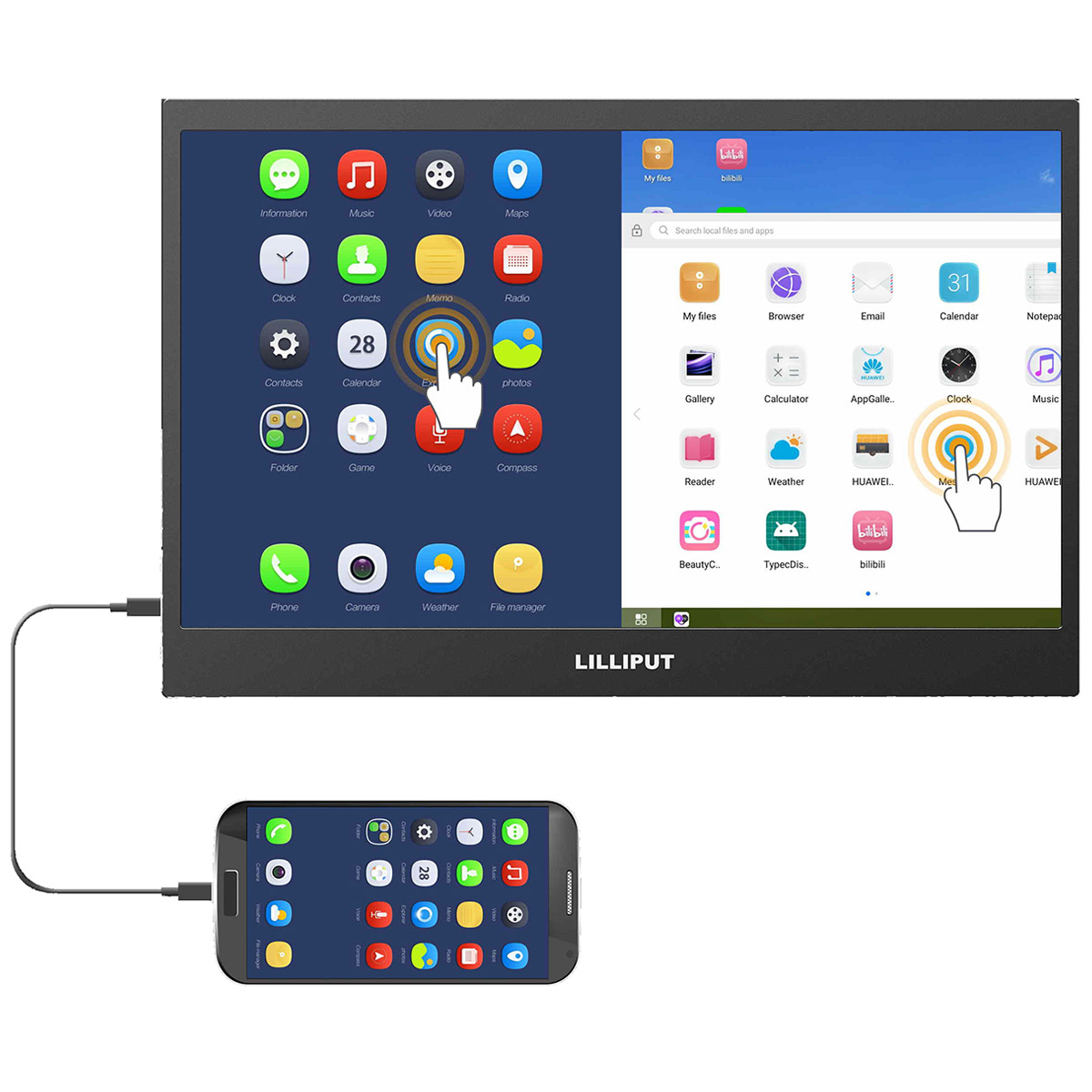
Today we're taking a look at the Feelworld DH101 10.1-inch portable touchscreen.
What do we find in the package? When you unpack the box, you'll find plenty of protective materials to keep the display safe. The display is wrapped, with a manual underneath, USB-C to USB-C, USB-A to USB-C, and HDMI to mini-HDMI cables. You can use this touch and thin display for work, but also as a monitor for tablets and mobile phones. The portable display supports many laptop brands such as Apple, Huawei, Honor, Xiaomi, Asus, Dell, HP, as well as Microsoft. It can also connect to mobile phones and tablets from Huawei, Honor, Samsung, Razer, LG, Oppo, Asus, HTC and Smartisan. It also works on a plug and play basis, so it doesn't run on a charger, but takes power from the device it's connected to.
How does it work? After you unpack the display and set it up using the integrated 90-degree bracket; select the cable that matches your device and plug it into the display's input one or two. The display should turn on and transmit the screen within 10 seconds. And what do we find on the display?
The display features an IPS panel with a 1280x800 pixel resolution, 900:1 contrast ratio, 160° viewing angles and 280 candela per m2 brightness, as well as a Mini-HDMI input and a pair of USB-C ports. There's also a 3.5mm headphone jack and USB-C Type 3 for connecting video sources, power, mouse or keyboard. There's an off/on button, control arrows and a menu button.
To simplify things, you can also customize the display, meaning you can set the colors, brightness, contrast, sharpness, placement, and size yourself or leave it to the machine. Your user experience is then enhanced by the integrated adjustable stand and built-in speakers. And it all weighs in at just 650g. The DH101 also supports touch control via USB-C cable on compatible phones, tablets and laptops.
For us, it's a great product that we can use in both our work and personal lives. The fact that the price ranges from 3 800 CZK adds a plus to this product. You can buy it HERE.