
 CZ
 SK
 HU
 AT
 DE
 ES
 SI
 HR

Nothing in the basket.

- Search
-
Login

-
0
Comparison
Add products to compare, then they will appear here and you can compare parameters.
-
0
0 €
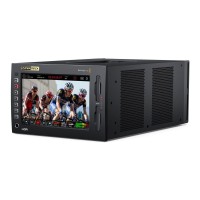
Blackmagic Design HyperDeck Extreme 4K HDR


SKU: HYPERD/RSTEX4KHDR
Professional recorder and player for SD, HD and Ultra HD up to 2160p60. HyperDeck Extreme 4K HDR combines a 7″ HDR touchscreen, broadcast connections, H.265 and ProRes codecs, built-in scopes and recording to CFast cards or external USB-C disks. Analog inputs and an optional M.2 cache make it a dependable recorder for broadcast as well as archive digitiza…
3 339 € with VAT
2 759.5 € without VAT
Availability
on request
Top accessories for Blackmagic Design HyperDeck Extreme 4K HDR
Infinitek L-4.5CHWS 5m FLEX 12G-SDI cable BNC-BNC
Canare L-4.5CHWS flexible and durable 75 ohm 4,2 mm "Low Loss" koaxial SD/HD/3G/12G-SDI
31 €
To be sent > 5 pcs
Infinitek L-4.5CHWS 2m FLEX 12G-SDI cable BNC-BNC
Canare L-4.5CHWS flexible and durable 75 ohm 4,2 mm "Low Loss" koaxial SD/HD/3G/12G-SDI
19 €
To be sent > 5 pcs
HDMI cable 2.0b UHD 4K High Speed + Ethernet 5,0m

Propojovací HDMI 2,0b kabel UHD 4K High Speed + Ethernet kabel
17 €
In stock 1 pcs
HDMI cable 2.0b UHD 4K High Speed + Ethernet 2,0m

Propojovací HDMI 2,0b kabel UHD 4K High Speed + Ethernet kabel
8.1 €
In stock 3 pcs
Exascend 512GB Archon CFast 2.0 Memory Card

The Archon CFast 2.0 memory card was developed jointly by Exascend and RED Digital
559 €
To be sent 2 pcs
Blackmagic Design MultiDock 10G
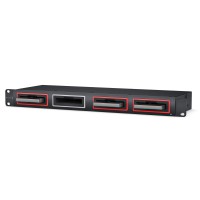
The Blackmagic MultiDock 10G is a 1RU rack dock for four 2.5″ SATA SSDs that you
669 €
on request
Blackmagic Design HyperDeck Extreme Control
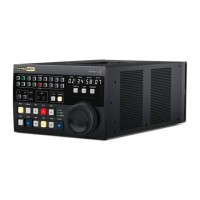
Professional control panel in the style of a classic broadcast tape deck. It controls
1 499 €
on request
Blackmagic Design HyperDeck Extreme Rack Kit
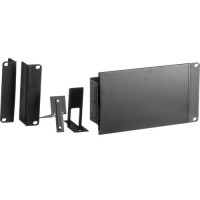
Lightweight rack kit for mounting two HyperDeck Extreme 8K HDR, HyperDeck Extreme
234 €
on request
Product description
ARTICLES
SPECIFICATIONS
PACKAGE CONTENT


Product description
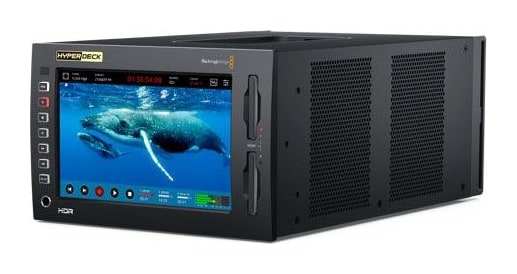
Professional recorder and player for SD, HD and Ultra HD up to 2160p60. HyperDeck Extreme 4K HDR combines a 7″ HDR touchscreen, broadcast connections, H.265 and ProRes codecs, built-in scopes and recording to CFast cards or external USB-C disks. Analog inputs and an optional M.2 cache make it a dependable recorder for broadcast as well as archive digitization.
Ultra HD recorder with an HDR touchscreen
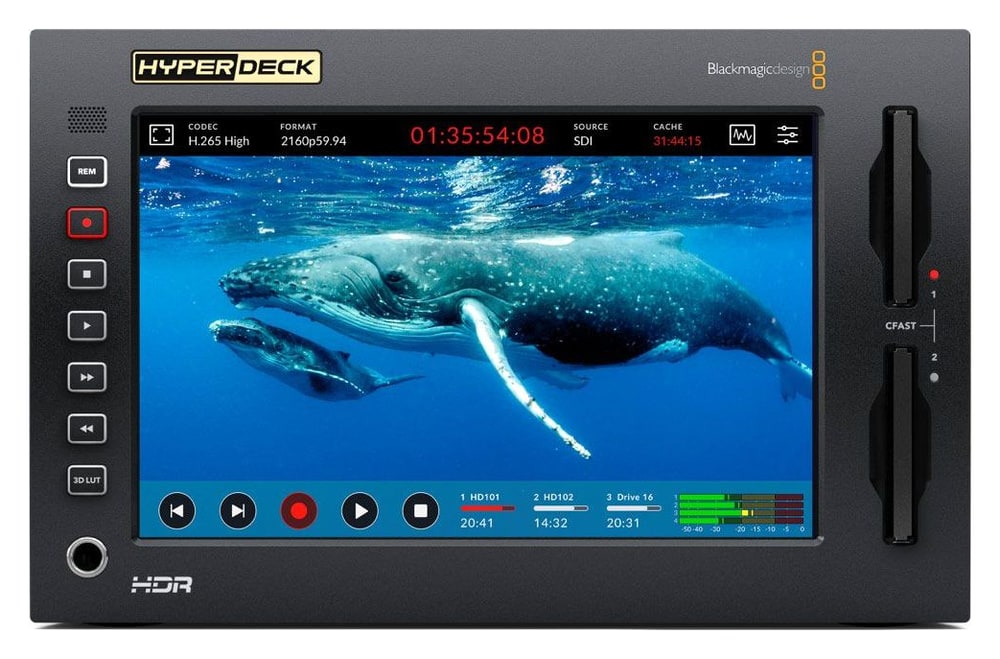
HyperDeck Extreme 4K HDR records and plays H.265, ProRes, DNx and H.264 in all SD, HD and Ultra HD standards up to 2160p60. The large touchscreen shows your recording as well as the scopes.
12G-SDI2160p607″ HDR LCD2× CFast 2.010G EthernetH.265 · ProRes · DNx
Mastering, clip playback and archive
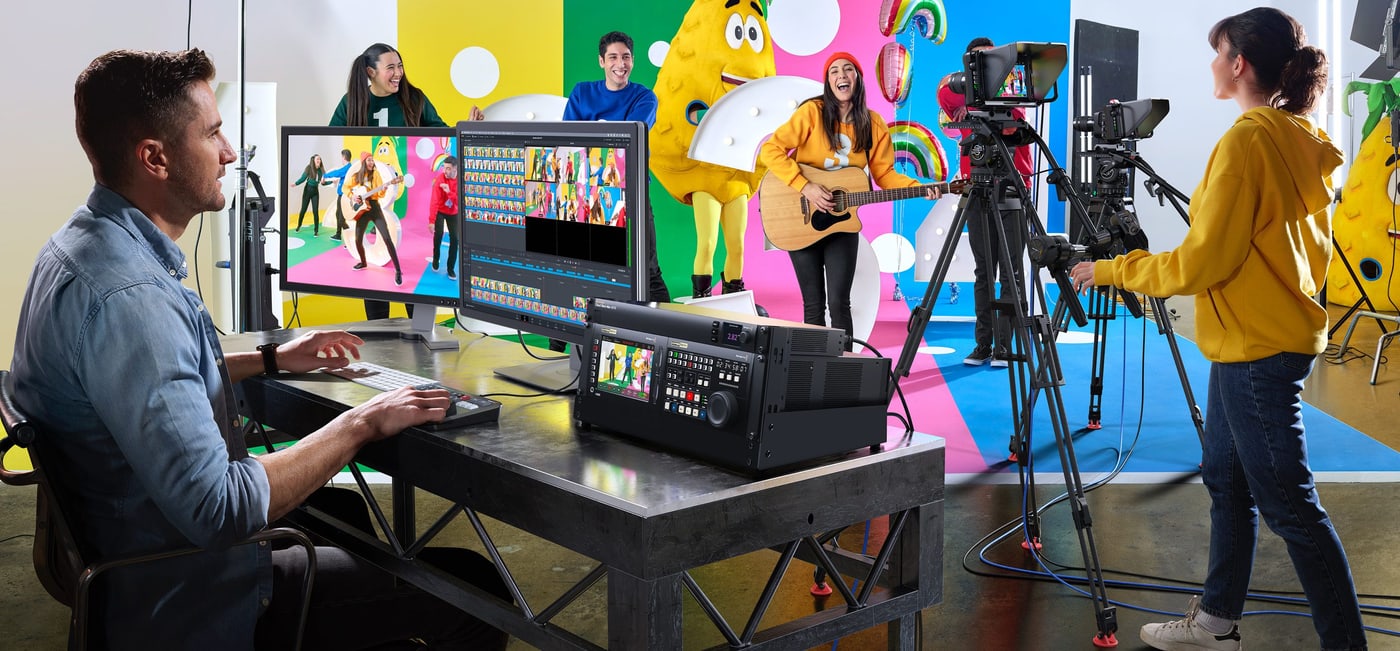
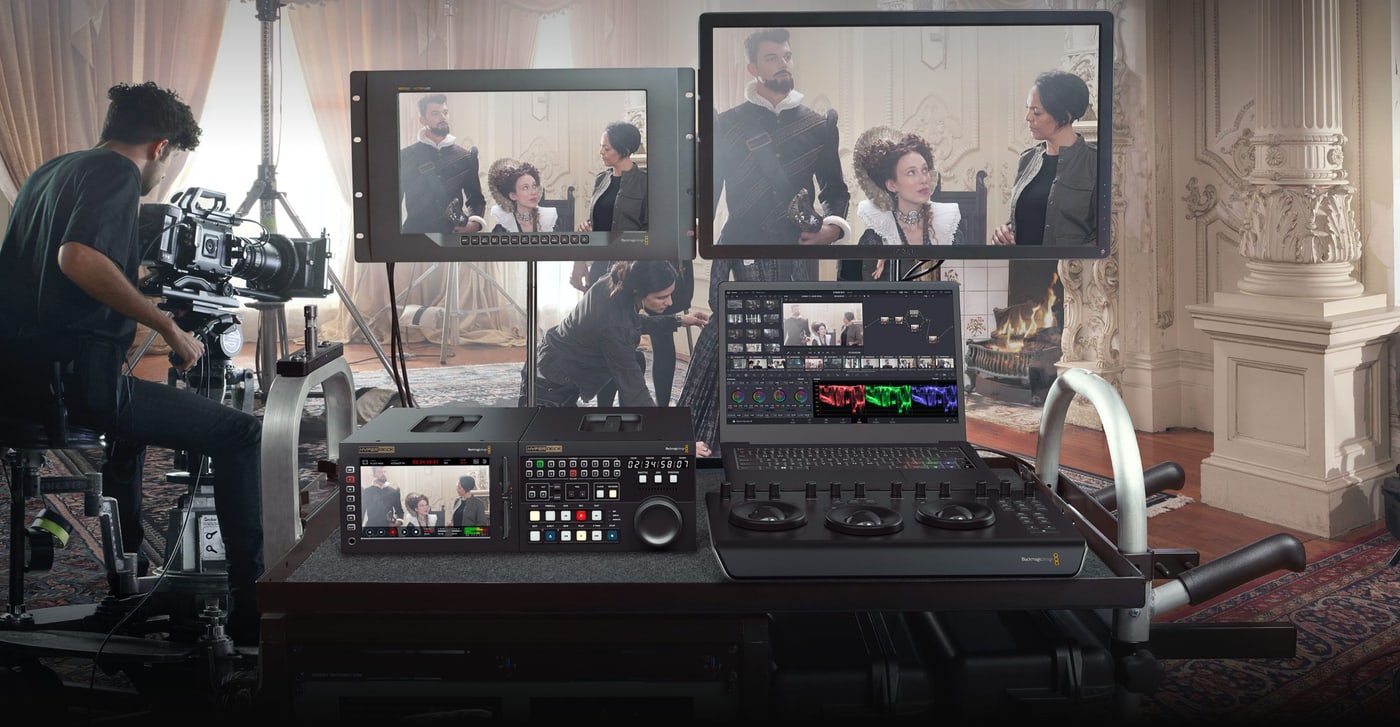
HyperDeck Extreme records broadcast masters, plays clips into live production, records ISO cameras and uses its analog inputs to transfer old tapes to files for editing and streaming services.
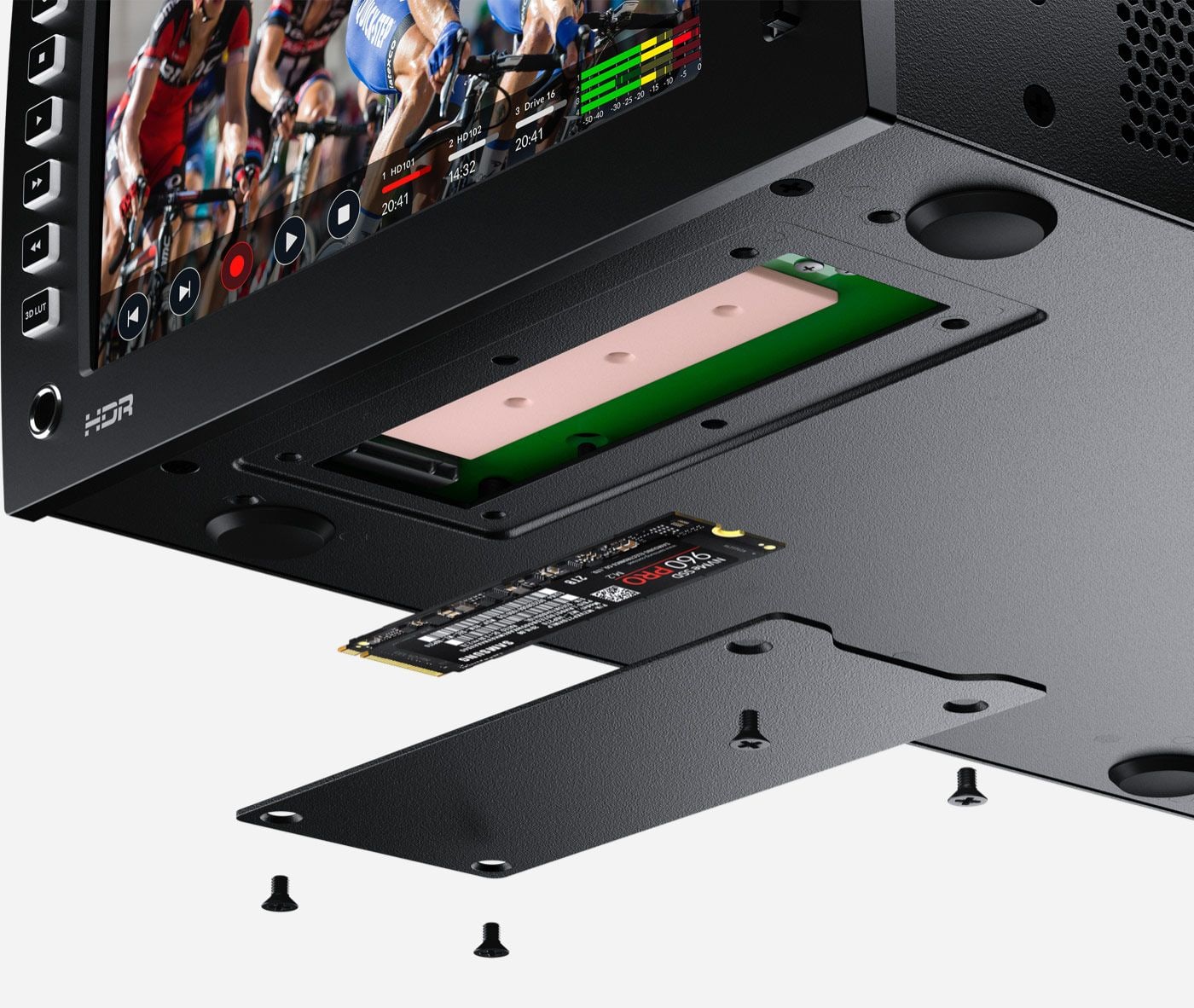
Cache against dropped frames
An optional M.2 NVMe card takes over recording when the media fills up or is too slow – with no dropped frames.
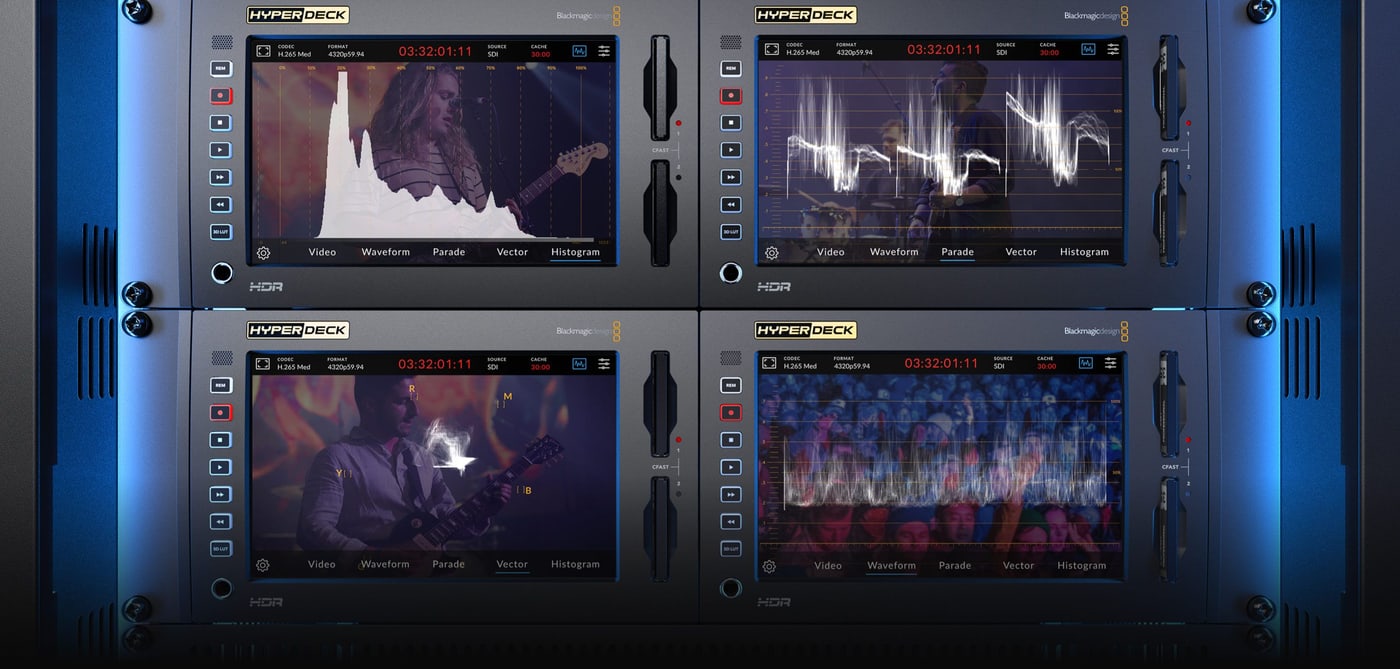
Scopes and 3D LUTs
Waveform, RGB parade, vectorscope and histogram in 10-bit quality, with HDR graticules and 33 point 3D LUTs.
12G-SDI, HDMI and analog
Multi-rate SDI, HDMI 2.0, component and composite video, XLR and RCA audio and XLR timecode.
Network and RS-422 control
10G Ethernet with FTP and a text protocol plus classic RS-422 control, for example from HyperDeck Extreme Control.
Modern design with traditional controls
The touch interface has buttons for play, stop and record, a mini timeline for scrolling through recordings and image swipe to jog. The front panel also has direct buttons for transport control, enabling the 3D LUT and remote, plus a speaker and a headphone output. The recorder has both AC and DC power connections for studio or location use.
Big bright touchscreen
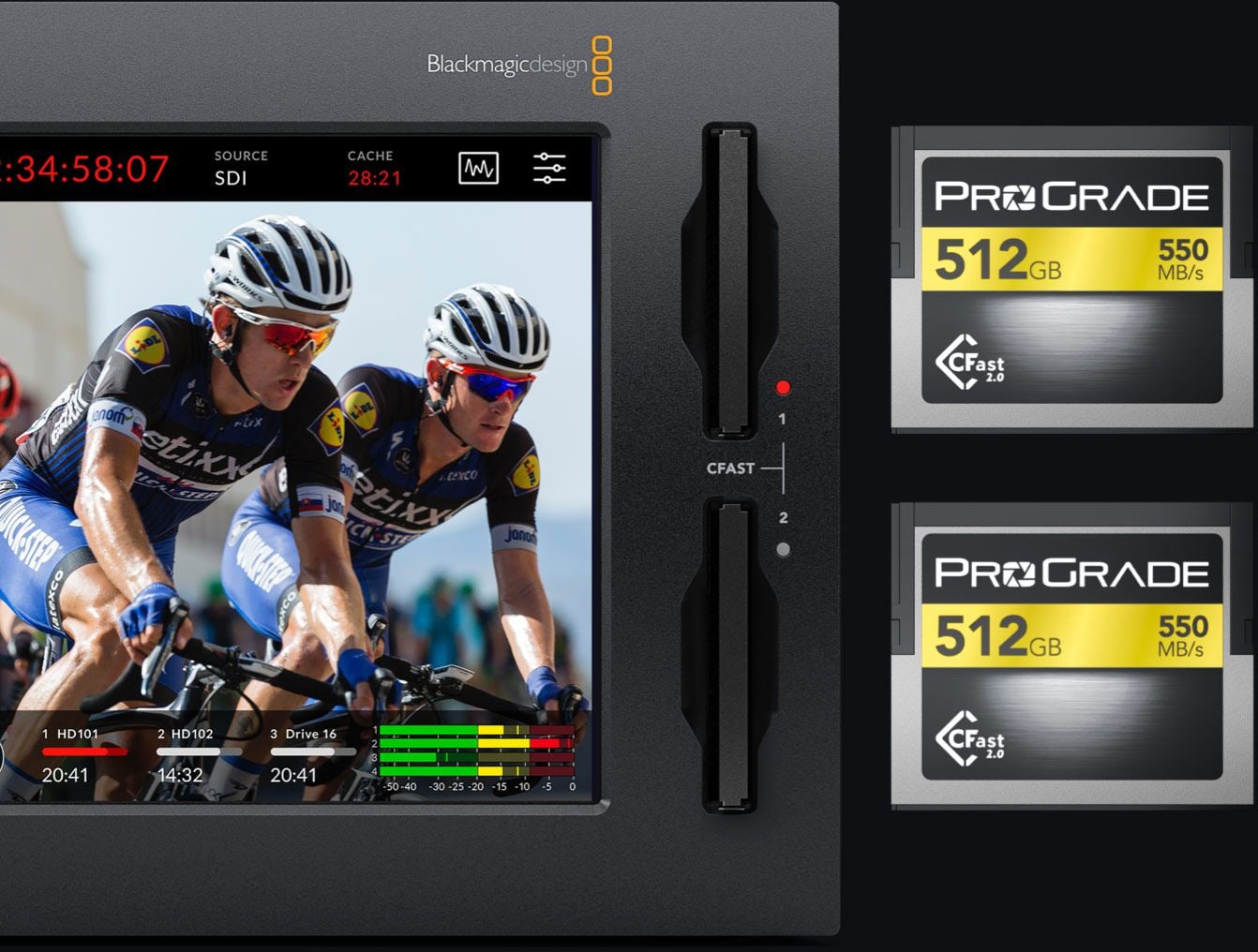
The 7″ 1920 × 1200 HDR LCD with 2000 nits shows timecode, video standard, media status and audio meters. From the screen you enable scopes, focus and exposure assist, load and save 3D LUTs and set up every function of the recorder.
Dual CFast cards for non-stop recording
The recorder records to commonly available CFast 2.0 cards. Space-saving H.265 files allow long recordings on standard cards, and with two slots you can swap a full card during recording, so recording length is unlimited. Blackmagic MultiDock 10G adds SSD compatibility.
Recording to external USB-C disks
The USB-C 3.1 Gen 2 expansion port (up to 10 Gb/s) records to external flash disks or disk arrays. You can record straight to the disk you edit from, with no copying, and fast disks handle data rates too high for CFast cards, such as ProRes in 4K. Disks are managed from menus on the touchscreen.
Optional media cache
An M.2 PCIe NVMe card (60, 80 or 110 mm, up to 16 Gb/s) can be installed in the recorder as a cache or for internal recording. When a card fills up or is too slow, the cache automatically takes over the recording, so there are no dropped frames. It even lets you record formats that are too fast for the card or the external disk.
Record direct to network storage
Build a rack of recorders for ISO recording that stores all cameras in a single folder on network storage. Edit suites log in to the storage and DaVinci Resolve can edit the media while it is still being recorded. You choose the target folder by browsing the network servers right on the screen.
12G-SDI, HDMI and analog connections
Multi-rate 12G-SDI handles SD, HD and Ultra HD, and the 12G-SDI outputs play fill and key from RGBA 4:4:4:4 files. HDMI 2.0 connects televisions and projectors, and for archiving there is component and composite video, balanced XLR analog audio, RCA HiFi inputs and XLR timecode. The down converted 3G-SDI monitor output includes overlays.
Convert legacy programming for streaming
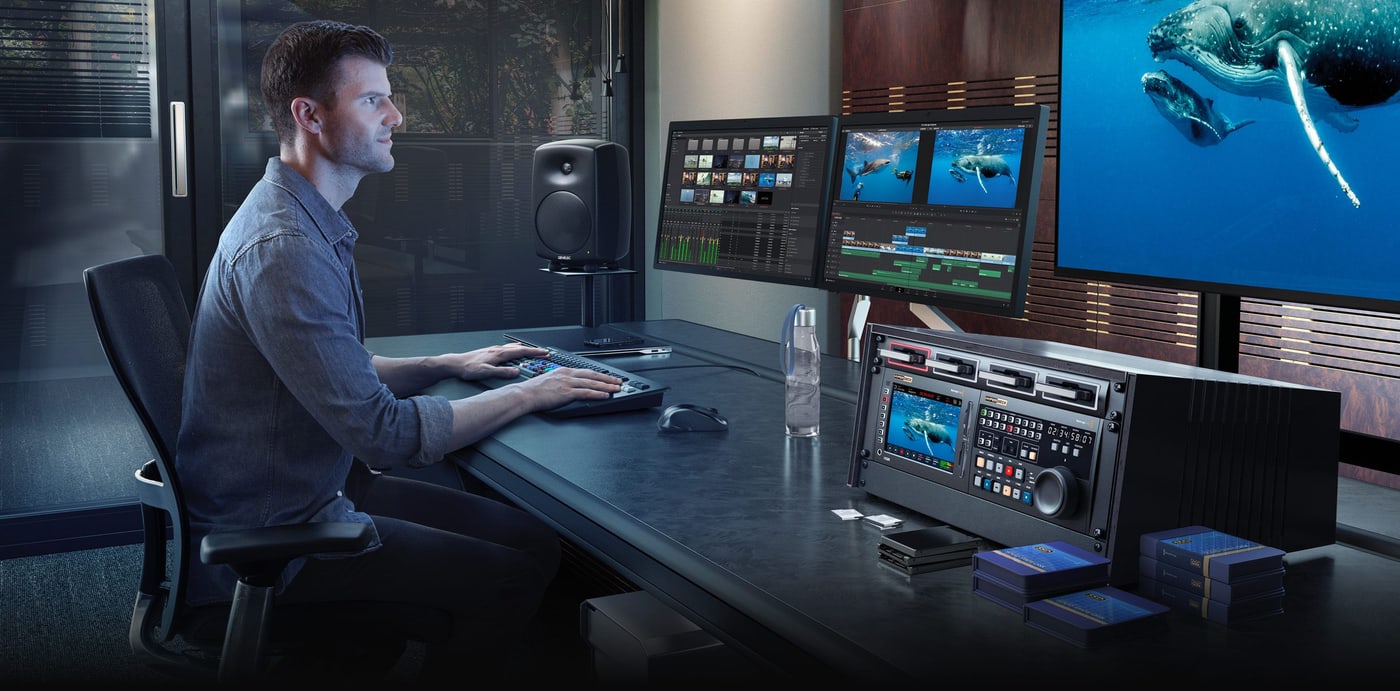
The analog inputs record from old video tapes, so archive programs can be used in editing or on streaming services. With HyperDeck Extreme Control the recorder connects to a legacy broadcast tape deck, you set the in and out points and transfer – Digital Betacam, 1″ C format and Betacam SP. Teranex Express converts tapes from SD to HD in one step.
Built-in scopes
The waveform shows the luminance levels of the input or playback, the vectorscope shows color intensity at 100% SDI reference levels, RGB and YUV parade help with color correction and checking for illegal levels, and the histogram shows the distribution from black to white including clipping. Scopes can be overlaid on live video or shown as a small picture in picture.
HDR and a wide gamut screen
The SDI and HDMI inputs detect HDR standards automatically, files are tagged with the correct HDR information and static metadata PQ and HLG are handled according to ST2084. The screen covers Rec. 2020 and Rec. 709 and 100% of DCI-P3, and the scopes change to HDR graticules when working in HDR.
Video standards up to Ultra HD 60p
SD in NTSC and PAL, 720p50 and 59.94, 1080i50 and 59.94, 1080p23.98 to 60 as well as 1080PsF formats. Ultra HD up to 2160p60, 2K and 4K DCI up to 25p. At 3G-SDI rates the recorder supports both level A and level B.
H.265 and ProRes for wide compatibility
H.265 files with compression ratios from 60:1 to 285:1 are extremely small and supported on all major operating systems. ProRes 422 HQ, 422 and LT are used for recording and playback, ProRes 4444 for playback with fill and key out. The recorder also works with DNxHD, DNxHR and H.264, so files open in DaVinci Resolve, Media Composer, Premiere Pro and Final Cut Pro.
Multi-channel SDI and analog audio
From SDI you record 2, 4, 8 or 16 channels of audio in real time. Four XLR analog inputs record all four channels from Betacam SP tape decks, and direct RCA HiFi inputs serve VHS, DVD and set top boxes. Levels are monitored on four audio meters with VU or PPM ballistics.
10G Ethernet for digital signage
Uploading files over the network is faster than transferring from CFast cards. The recorder is controlled with a simple text protocol – via Telnet you just type "play" or "record" – and files are uploaded via FTP. With large USB-C disk arrays it becomes a broadcast server for ingest, media management and playout.
RS-422 control like broadcast tape decks
The RS-422 protocol, originally developed by Sony, has been the most widely used control on broadcast gear since the 1980s. The recorder also supports Advanced Media Protocol commands for managing disk recorders and identifies itself with the ID 0xF0E0 (30/60p), 0xF1E0 (25/50p) or 0xF2E0 (24p).
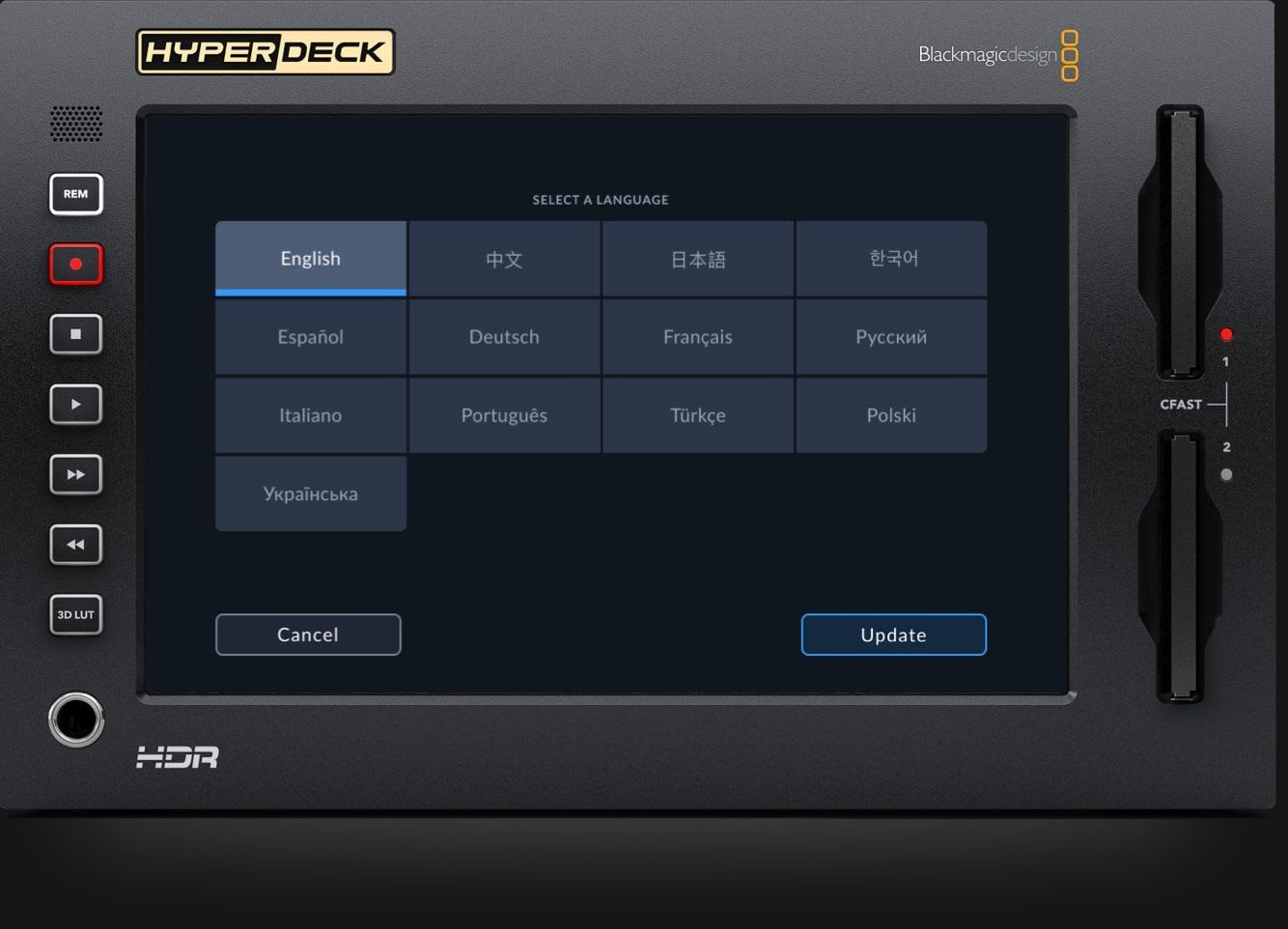
Menus in 13 languages
The recorder is localized into English, Chinese, Japanese, Korean, Spanish, German, French, Russian, Italian, Portuguese, Turkish, Polish and Ukrainian. The selected language applies to the menus, the on-screen overlays and the SDI monitor output.
Files for common software
Media are formatted as ExFAT or HFS+, so a computer reads them like regular disks. DaVinci Resolve combines editing, color correction, audio and visual effects and is free for Mac, Windows and Linux; files also open in Premiere Pro or Final Cut Pro.
Connections and controls
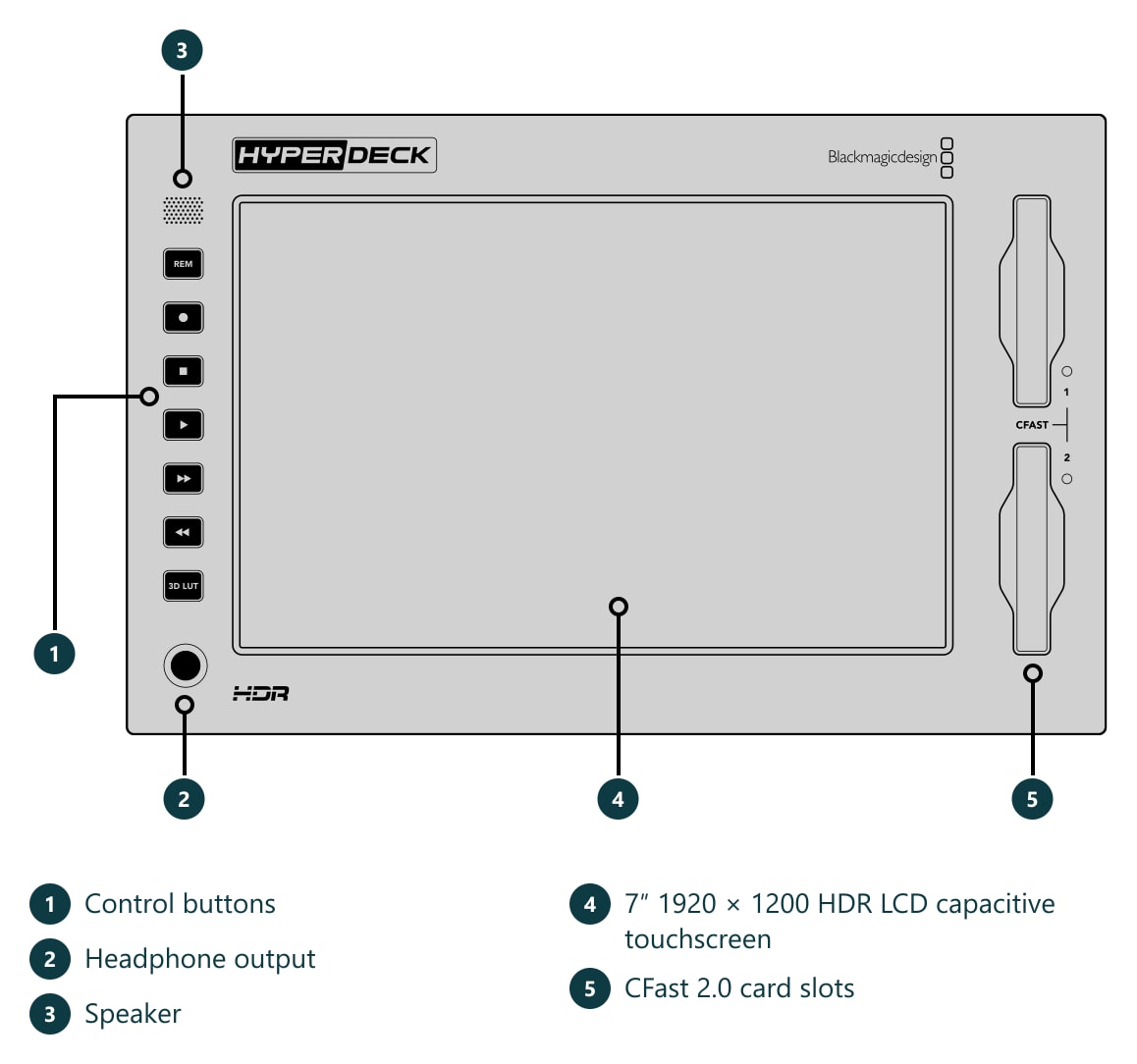
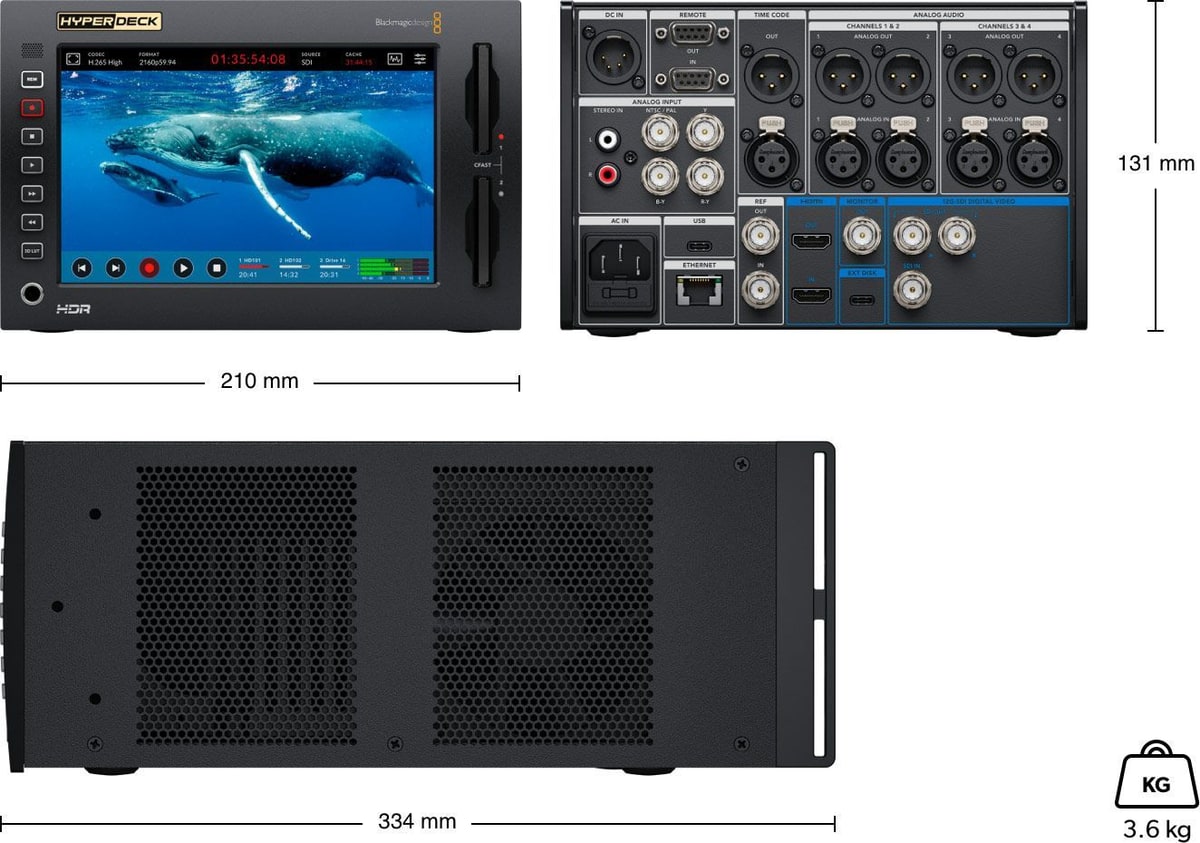
The front panel has control buttons, a headphone output, a speaker, the 7″ touchscreen and two CFast 2.0 card slots.
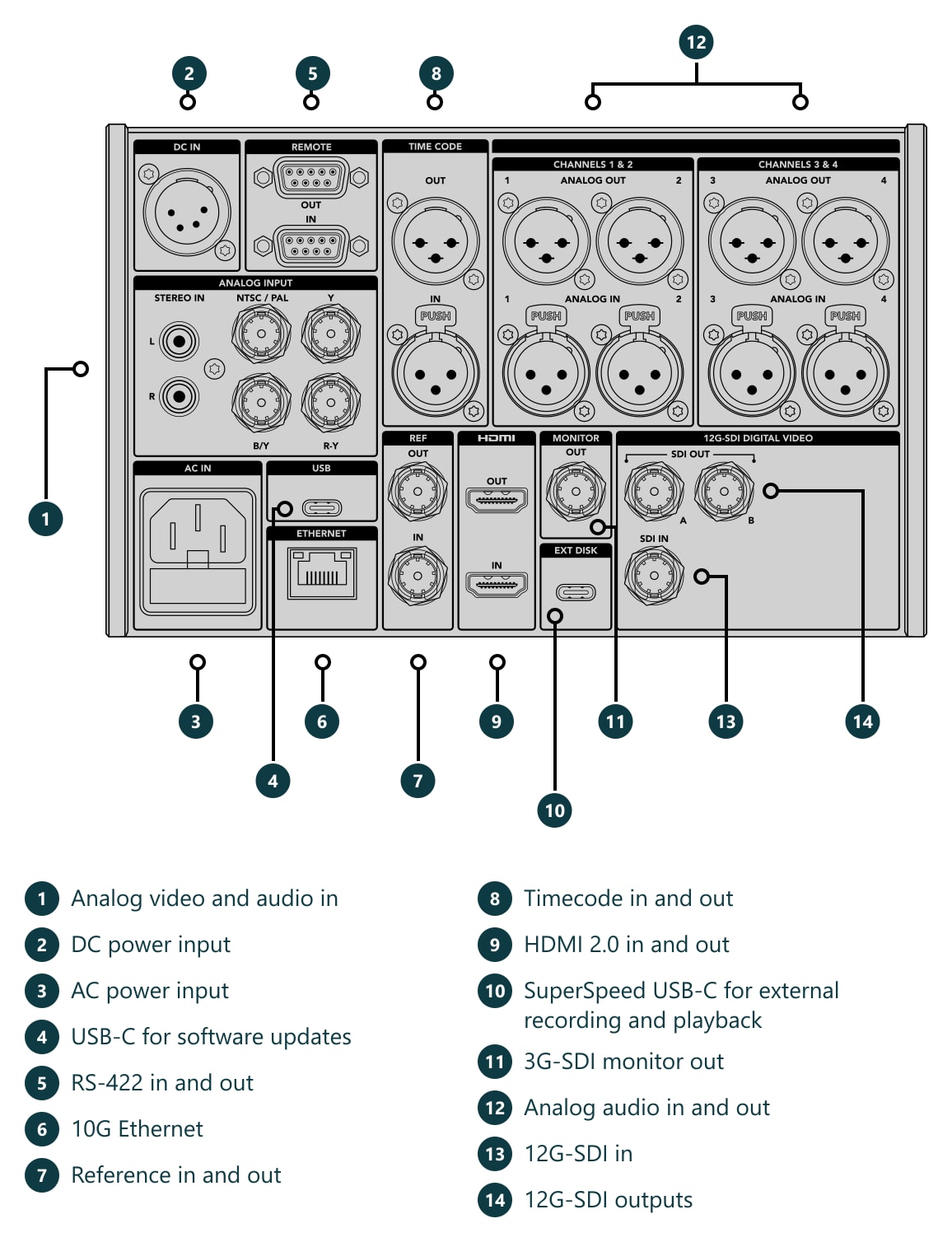
The rear panel has analog video and audio inputs, DC and AC power, USB-C, RS-422, 10G Ethernet, reference, timecode, HDMI 2.0, USB-C for external recording, a 3G-SDI monitor output, XLR analog audio, a 12G-SDI input and 12G-SDI outputs.
Dimensions and weight
210 × 131 × 334 mm (W × H × D), weight 3.6 kg. 3 rack units high, half rack width.
More information
Ultra HD mastering, HDR and legacy transfers
HyperDeck Extreme 4K HDR is a studio video recorder for recording 4K material to H.265, with an HDR touchscreen and built-in signal measurement. H.265 reduces storage requirements, while ProRes remains available for common post production workflows.
The touchscreen is used for preview, control, working with 3D LUTs and displaying the waveform, vectorscope, RGB/YUV parade or histogram. The multi-rate 12G-SDI and HDMI connections support SD, HD, 2K and Ultra HD up to 2160p60.
Analog video, HiFi and professional audio inputs allow legacy programs to be digitized. Two CFast slots allow continuous recording with media swaps, external disks connect via USB-C and 10G Ethernet speeds up remote file uploads and control.
The optional HyperDeck Extreme Control adds classic jog/shuttle and RS-422 control, so the 4K recorder can work both as a traditional studio recorder and as a workstation for archive transfers.
PACKAGE CONTENT
- HyperDeck Extreme 4K HDR
- Power cable
- Welcome wallet with QR code for software download
SPECIFICATIONS
- Display: 7″ 1920 × 1200 HDR LCD, 2000 nits, 100% DCI-P3, capacitive touchscreen
- SDI: 1× input 12G-SDI; 2× output 12G-SDI (A, B); 1× monitor output 3G-SDI; rates 270 Mb/s, 1.5G, 3G, 6G, 12G
- HDMI: 1× input, 1× output HDMI 2.0
- Analog video: component YUV (3× BNC); composite NTSC/PAL (BNC)
- Analog audio: 4 channels of balanced XLR audio (inputs) and 2 channels of unbalanced RCA
- Speaker and headphones: built-in mono speaker, headphone output
- Timecode: 1× XLR in, 1× XLR out
- Reference: tri-sync or black burst input
- SDI / HDMI audio: SDI 64 channels embedded; HDMI 8 channels embedded
- Remote control: 1× RS-422 in, 1× RS-422 out; SDI start/stop, timecode run; Blackmagic HyperDeck Ethernet Protocol
- Ethernet: 10 Gb/s
- USB-C: 1× USB-C 3.1 Gen 2 (up to 10 Gb/s) for external recording; 1× USB-C for software updates
- Media: 2× CFast 2.0; external USB-C flash disks (SD, HD, Ultra HD); M.2 PCIe NVMe slot 60, 80 or 110 mm (up to 16 Gb/s) for cache or internal recording; ExFAT, HFS+
- Video standards: SD (525i59.94 NTSC, 625i50 PAL), 720p50–60, 1080i50–60, 1080p23.98–60, 1080PsF23.98–30, 2K DCI 23.98–25p, 2160p23.98–60, 4K DCI 23.98–25p
- SMPTE compliance: SMPTE 259M, 292M, 296M, 424M, 425M (A, B), 2081-1, 2081-10, 2082-1, 2082-10, 2084
- SDI metadata: HD RP188, CEA-708 closed captioning, HDR metadata over SDI
- Sampling: video 4:2:2 YUV, 10-bit; audio 24-bit, 48 kHz
- Color space: Rec. 601, Rec. 709, Rec. 2020; 33 point 3D LUTs
- Video codecs: ProRes HQ, 422, LT, Proxy up to 2160p60; ProRes 4444 playback up to 2160p60 with fill and key routed to SDI A and B; DNxHD 220x, 145, 45 (MOV, MXF) for 720p and 1080p up to 60p; DNxHR HQX, SQ, LB (MOV, MXF) for 2K DCI and 2160p up to 60p; H.265 High, Medium, Low 4:2:0 10 bit for 2160p up to 60p; H.264 SDI 4:2:2 10 bit, High, Medium, Low 4:2:0 8 bit up to 1080p60
- Audio codecs: AAC 2 channels; PCM 2, 4, 8, 16, 32 or 64 channels
- Scopes: waveform, RGB parade, vectorscope, histogram (10-bit); picture in picture, overlay with opacity control, HDR graticules, vectorscope zoom
- Control panel: integrated capacitive touchscreen LCD with on-screen controls
- Software: Blackmagic OS, Blackmagic HyperDeck Setup; Mac 15.0 Sequoia, Mac 26.0 Tahoe or later, Windows 11
- Power: 1× internal 100–240 V AC; 1× 4 pin XLR 12 V DC for external power or battery
- Power usage: max. 190 W
- Installation: 3 rack units high, half rack width
- Dimensions (W × H × D): 210 × 131 × 334 mm
- Weight: 3.6 kg
- Operating temperature: 0 to 40 °C
- Storage temperature: −20 to 60 °C
- Relative humidity: 0 to 90% non-condensing
- Optional accessories: HyperDeck Extreme Control, HyperDeck Extreme Rack Kit
- Warranty: 1 year limited manufacturer warranty
ARTICLES
WE RECOMMEND
HyperDeck Extreme 4K HDR is a studio recorder and player with 12G-SDI, HDMI 2.0 and analog inputs that records H.265, ProRes, DNx and H.264 up to 2160p60. These products complete it into a full workstation.
CFast 2.0 cards – Media for the two CFast slots; when one card fills up, recording continues on the other.
- Exascend 512GB Archon CFast 2.0 Memory Card
- Exascend 512GB CFX Series CFast 2.0 Memory Card
- Exascend 1TB CFX Series CFast 2.0 Memory Card
Storage, control and rack – An SSD dock connected via USB-C, classic broadcast recorder controls and a rack kit.
- Blackmagic Design MultiDock 10G
- Blackmagic Design HyperDeck Extreme Control
- Blackmagic Design HyperDeck Extreme Rack Kit
Cables – 12G-SDI cables for inputs and outputs and HDMI cables.
Parameters
| Manufacturer: | Blackmagic Design |
| Category: | Studio recorders |
Main parameters
| Form factor | Desktop · Rack |
| Format/Codec | DNxHR · DNxHD · ProRes · MOV · MXF · H.265 · H.264 |
| Supported resolution | 4K DCI/24p, 25p, 30p · UHD/50p, 60p · UHD/24p, 25p, 30p · 2K/24p, 25p · 1080/50p, 60p · 1080/24p, 25p, 30p · 1080/50i, 60i · 720/50p, 60p · 480i/576i |
| Input | Component · Composite · HDMI · 12G SDI |
| Recording medium | SSD · CFast |
Other parameters
| Display resolution | 1920x1200px |
| Diagonal | 7" |
| Other features | Remote control · Ethernet |
| Touchscreen display | Yes |
| Power supply type | Internal · Power supply |
| SDR/HDR | HDR |
Blog and news
Date: 13. 03. 2025, Category: Blog
Blackmagic Design: Replay workflow
Replay workflow with Blackmagic Design With its DaVinci Resolve Replay Editor, Blackmagic Design provides a reliable solution for professional slow…

Date: 20. 01. 2025, Category: Blackmagic Design
HyperDeck 8.5 Update - HyperDeck Extreme 4K/8K HDR
HyperDeck 8.5 update for HyperDeck Extreme 4K and 8K HDR With the New Year came several new releases from Blackmagic Design, and one of them is the…
ACCESSORIES (8)
ACCESSORIES (8)
Infinitek L-4.5CHWS 5m FLEX 12G-SDI cable BNC-BNC
Canare L-4.5CHWS flexible and durable 75 ohm 4,2 mm "Low Loss" koaxial SD/HD/3G/12G-SDI
31 €
To be sent > 5 pcs
Infinitek L-4.5CHWS 2m FLEX 12G-SDI cable BNC-BNC
Canare L-4.5CHWS flexible and durable 75 ohm 4,2 mm "Low Loss" koaxial SD/HD/3G/12G-SDI
19 €
To be sent > 5 pcs
HDMI cable 2.0b UHD 4K High Speed + Ethernet 5,0m
Propojovací HDMI 2,0b kabel UHD 4K High Speed + Ethernet kabel
17 €
In stock 1 pcs
HDMI cable 2.0b UHD 4K High Speed + Ethernet 2,0m
Propojovací HDMI 2,0b kabel UHD 4K High Speed + Ethernet kabel
8.1 €
In stock 3 pcs
Exascend 512GB Archon CFast 2.0 Memory Card
The Archon CFast 2.0 memory card was developed jointly by Exascend and RED Digital
559 €
To be sent 2 pcs
Blackmagic Design MultiDock 10G
The Blackmagic MultiDock 10G is a 1RU rack dock for four 2.5″ SATA SSDs that you
669 €
on request
Blackmagic Design HyperDeck Extreme Control
Professional control panel in the style of a classic broadcast tape deck. It controls
1 499 €
on request
Blackmagic Design HyperDeck Extreme Rack Kit
Lightweight rack kit for mounting two HyperDeck Extreme 8K HDR, HyperDeck Extreme
234 €
on request
Alternative (4)
Alternative (4)
Datavideo HDR-80 4K ProRes Video Recorder

Datavideo HDR‑80 is a desktop recorder and player for UHD 4K and HD video. It records
3 529 €
In stock 1 pcs
Blackmagic Design HyperDeck Shuttle 4K Pro 2TB
HyperDeck Shuttle 4K Pro with a pre-installed 2 TB M.2 PCIe NVMe card. It combines
3 269 €
In stock 1 pcs
Datavideo HDR-90 1RU Rackmountable ProRes 4K Video Recorder

The Datavideo HDR-90 is a rackmount video recorder with LCD that controls and manages
3 529 €
14-30 days
Blackmagic Design HyperDeck Extreme 8K HDR
High-end 8K broadcast recorder and player with Quad Link 12G-SDI, recording up to
5 999 €
on request

News, training, and discounts from Syntex
Special offers and discounts for subscribers only · Free audio & video workshops · News and tips from the world of filmmaking
- Show all

Blackmagic Design HyperDeck Extreme 4K HDR
Professional recorder and player for SD, HD and Ultra HD up to 2160p60. HyperDeck3 339 €on request
Sound Devices SL-2
New accessory for 833, 888 and Scorpio mixers/recorders. It is the first product2 679 €14-30 days
ZEISS Compact Prime CP.3 100mm T2.1 (PL, Metric)
The ZEISS CP.3 lenses are supplied with PL mount as standard but can also be ordered5 209 €3-5 days