
 CZ
CZ SK
SK HU
HU AT
AT DE
DE ES
ES SI
SI HR
HR
Nothing in the basket.

- Search
-
Login

-
0
Comparison
Add products to compare, then they will appear here and you can compare parameters.
-
0
0 €
News
Titan HD Extract is the latest upgrade option for the Odyssey & Apollo camera monitor/recorders. Titan HD Extract uses one 4K camera to create three HD video signals. One frame is a Super Sample of the full image area and two are windows selected from within the original input. These windows can be panned smoothly through the 4K field and the three angles can be Live-Switched. All four HD signals can be recorded simultaneously in Apple ProRes with matching timecode and file names.
With Titan HD Extract, you can:
- Shoot a two-subject interview using one camera and Titan and record a Live-Switch of a two-shot plus separate close-ups.
- Record a panel presentation with a wide master plus a single on the moderator and another of the panel, all from one camera.
- Cover a House of Worship service with a shot of the clergyman, another of the chorus, and a wide view of them all – done with the modest investment of one camera and Titan.
- With Titan HD Extract and a single installed camera capture an entire football field from the 50 yard line, plus follow a player as he runs the course of the field.
Titan accepts 4K video signals over HDMI and SDI (original Odyssey7Q limited to 3G-SDI). Titan also accepts 4K RAW data from the Sony FS5, FS7 & FS700 cameras. Live-Switching is available as cuts and dissolves, and an Edit Decision List is generated as an EDL file for conforming an edit in post.
Titan HD Extract is an upgrade option for the Odyssey7Q+, Odyssey7Q and Apollo monitor/recorders. Other options (Odyssey RAW Bundle or Apollo) are not required for Titan. Titan list price will be 1295 USD, and it is is expected to be available around the beginning of October. See Titan in person at the Convergent Design booth 12.A34 at IBC 2016.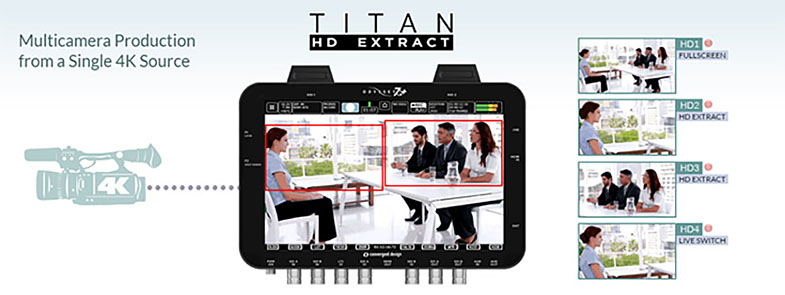
Date: 08. 09. 2016,
Category: News
FULL ARTICLE
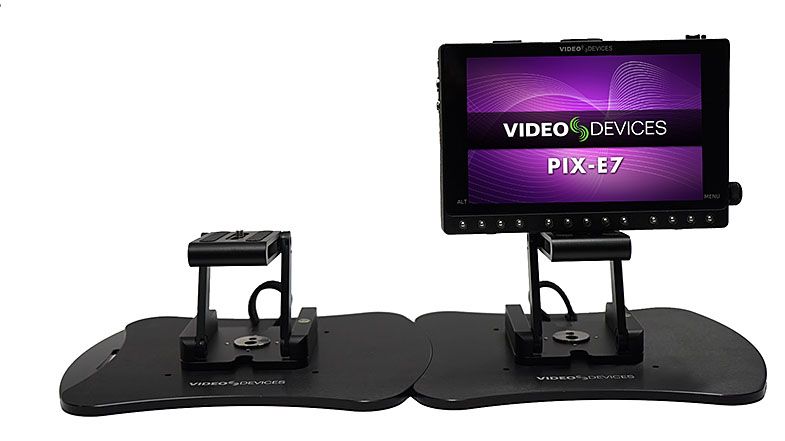
Since the introduction of H.264 recording and simultaneous dual codec (H.264/ProRes) recording capability in Video Devices PIX-E family, there has been a strong demand for a secure and stable way to mount these units when not attached to a camera. In response to these requests Video Devices have created the PIX-Base to securely position your PIX-E or PIX 240i models for viewing and operation during a live event or portable production environment.
The PIX-Base features
- Solid and robust metal base with rubber feet. Will not easily slide or move. Mounts via 1/4" 20-thread mounting hole. Can be used with PIX-E monitors with or without the PIX-LR audio accessory attached. Can also be used with any device with 1/4" 20 screw hole.
- Adjustable height and angle.
- Velcro wrap for neat cable connection.
- Easily collapsible and transportable.
- A mounting holes for 'permanently' fixing PIX-Base to a table or other structure.
- Easy-to-use Interlocking base enables multiple PIX-Bases to be linked together. No tools required.
Date: 08. 09. 2016,
Category: News
FULL ARTICLE
Panasonic will introduce a new cinema-ready version of the VariCam 35 at IBC 2016, featuring a jointly developed Codex recorder capable of uncompressed, 4K RAW acquisition. The so called VariCam Pure is the latest addition to the company's family of professional cinematography products. A co-production between Panasonic and Codex, it couples the existing VariCam 35 camera head with a new Codex V-RAW 2.0 recorder, ideal for episodic television shows and features. The V-RAW 2.0 recorder attaches directly to the back of the VariCam 35 camera head. As a result, the camera retains the same Super 35 sensor, 14+ stops of latitude and dual native ISO as the original VariCam 35. Codex will provide the most efficient dailies and archiving workflow available through its Production Suite. In addition, the Codex Virtual File system means users can transfer many file formats including Panasonic VRAW, Apple ProRes and Avid DNxHR. Using the Codex Capture Drive means a reliable workflow from digital capture to post production. Along with the original camera negative, frame-accurate metadata (such as lens and CDL data) can also be captured, streamlining production and post-production, and delivering time and cost savings. The V-RAW 2.0 recorder for Varicam Pure is scheduled for release at the end of 2016 for under €30,000. The camera will be showcased at IBC 2016 on Stand C45, Hall 11.
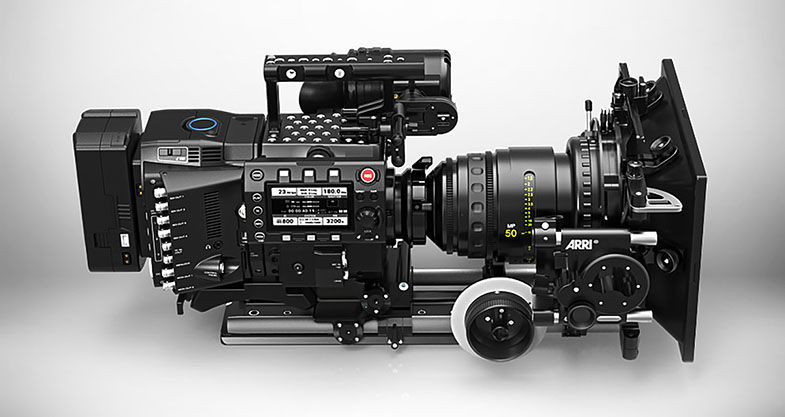
Panasonic has also expanded the number of cost-saving camera kit packages for the VariCam LT Super 35mm Cinema Camera to five with the addition of the PROEX-B512 package, featuring the completely accessorized camcorder along with two AU-XP0512BG expressP2 memory cards and an AU-XPD1 expressP2 Card Reader. The 512GB expressP2 cards can record approximately 180 minutes of continuous 4K material at 24fps in the AVC-Intra4K422 codec. All five VariCam LT packages are currently available for purchase:
– The VariCam LT is a basic camera kit including the camera body, top handle, control panel and con-trol panel mounting bracket.
– The VariCam LT-VF package, contains the basic kit plus the AU-VCVF10 OLED Viewfinder.
– The VariCam LT-PRO includes the camera body with basic kit accessories, AU-VCVF10G viewfinder, shoulder mount, operating grip and PL lens mount.
– The VariCam LT-PROEX includes all of the contents of the VariCam LT-PRO package (camera kit, viewfinder, shoulder mount, operating grip and PL mount) plus two 256GB expressP2 cards and an expressP2 drive.
– The VariCam LT- PROEX-B512, the most extensive accessory package, contains all the con-tents of the VariCam LT-PROEX package, but with two 512GB expressP2 cards vs. two 256GB cards.
Date: 07. 09. 2016,
Category: News
FULL ARTICLE
Two new in podcasts in the EDIUS Podcast series cover new EDIUS 8 GV Browser file organizer and new motion tracking features first introduced in EDIUS 8.2. Visit podcast.edius.net YouTube channel to watch the ongoing podcast series.
Date: 06. 09. 2016,
Category: News
FULL ARTICLE
Panasonic HC-X1 is a light, compact 4K Ultra HD professional camcorder. It supports 4K 24p, UHD 60p/50p, FHD 60p/50p multi-format recording and HD super slow-motion. The X1 includes professional features such as 2-channel XLR Audio, Wired/Wireless remote control, triple manual rings, a user switch, timecode, ND Filters and twin SD card slots. Additionally the X1 offers Live HDMI output along with a wide 24mm angle LEICA DICOMAR 4K Lens and optical 20x zoom. Available from December 2016.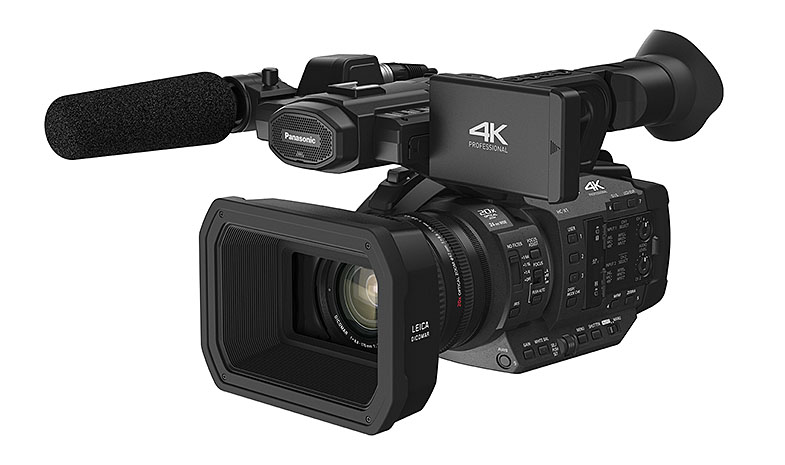
Date: 05. 09. 2016,
Category: News
FULL ARTICLE