
 CZ
CZ SK
SK HU
HU AT
AT DE
DE ES
ES SI
SI HR
HR
Nothing in the basket.

- Search
-
Login

-
0
Comparison
Add products to compare, then they will appear here and you can compare parameters.
-
0
0 €
Feelworld D71 PLUS-H
SKU: D71 PLUS-H
A dual seven-inch rack monitor with a 3U installation height for the broadcast gallery, the edit suite and the OB van. Two independent 1920 × 1200 IPS panels with 4K HDMI and composite video in and out, a three-colour tally beside each screen, waveform with vector scope and up to 32 custom 3D LUTs. It can also be set up over the network from a computer. The…
479 € with VAT
395.87 € without VAT
Availability
on request
Top accessories for Feelworld D71 PLUS-H
SmallRig Ultra-Slim 4K HDMI Data Cable (A to A) (100cm) 4794
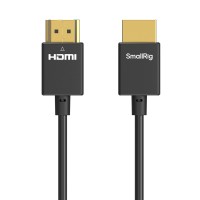
An ultra-slim HDMI 2.0 data cable, A to A, 100 cm long and just 3.6 mm across. It
13 €
In stock > 5 pcs
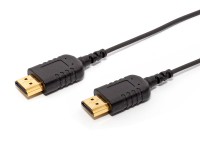
Infinitek HDMI TO HDMI ultra thin flixible 4K cable, 80cm
Promotion: -20%
Infinitec ultra tenký a flexibilný 4K HDMI v 2,0 kábel pre kreatívnych profesionálov.
18.48 €
22.99 €
In stock > 5 pcs
HDMI cable 2.0 UHD 4K High Speed + Ethernet 10m
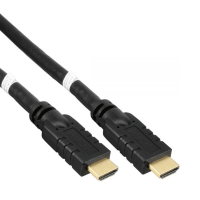
Propojovací HDMI 2,0 kabel UHD 4K High Speed + Ethernet kabel s integrovaným zes
48 €
In stock 2 pcs
HDMI cable 2.0b UHD 4K High Speed + Ethernet 3,0m
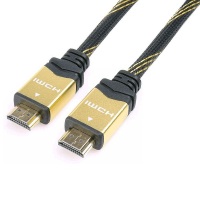
Propojovací HDMI 2,0b kabel UHD 4K High Speed + Ethernet kabel
9.3 €
To be sent 2 pcs
Product description
SPECIFICATIONS
PACKAGE CONTENT

Product description
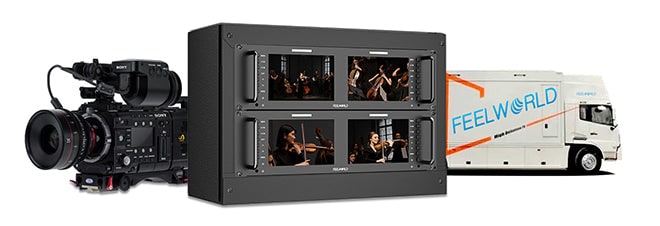
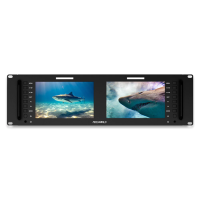
A dual seven-inch rack monitor with a 3U installation height for the broadcast gallery, the edit suite and the OB van. Two independent 1920 × 1200 IPS panels with 4K HDMI and composite video in and out, a three-colour tally beside each screen, waveform with vector scope and up to 32 custom 3D LUTs. It can also be set up over the network from a computer. The -H variant is HDMI-only; the version with SDI is called the D71 PLUS.
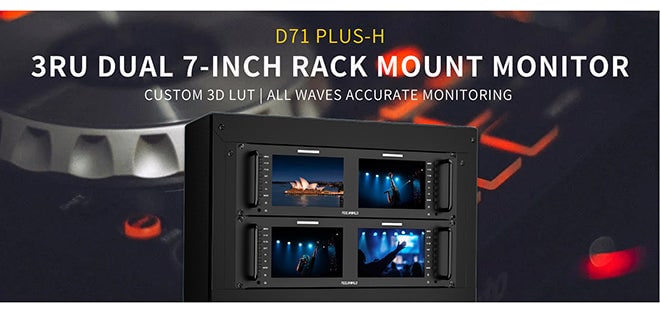
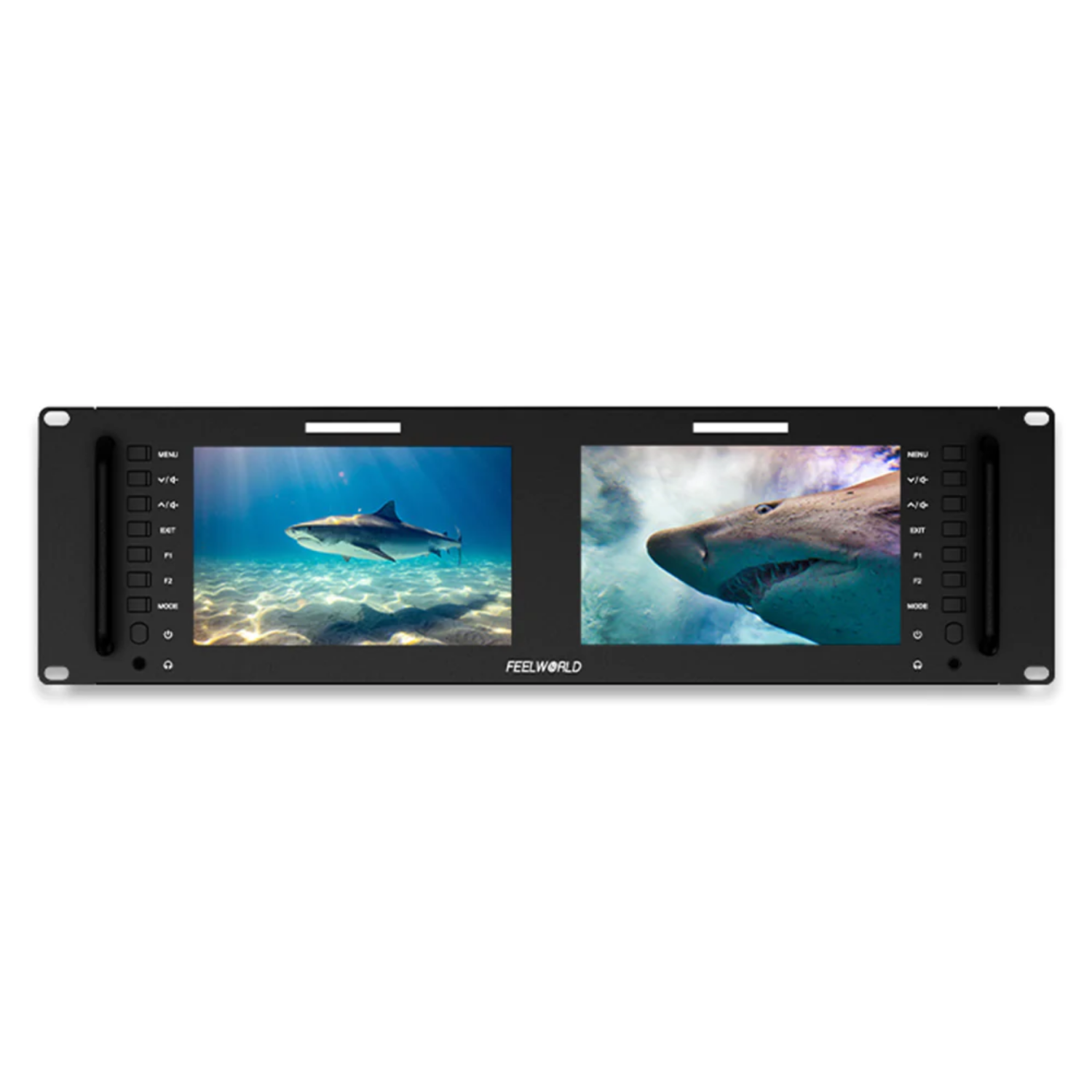
Two seven-inch panels in a single rack unit
3U installation height, 30.5 mm deep, two independent setups
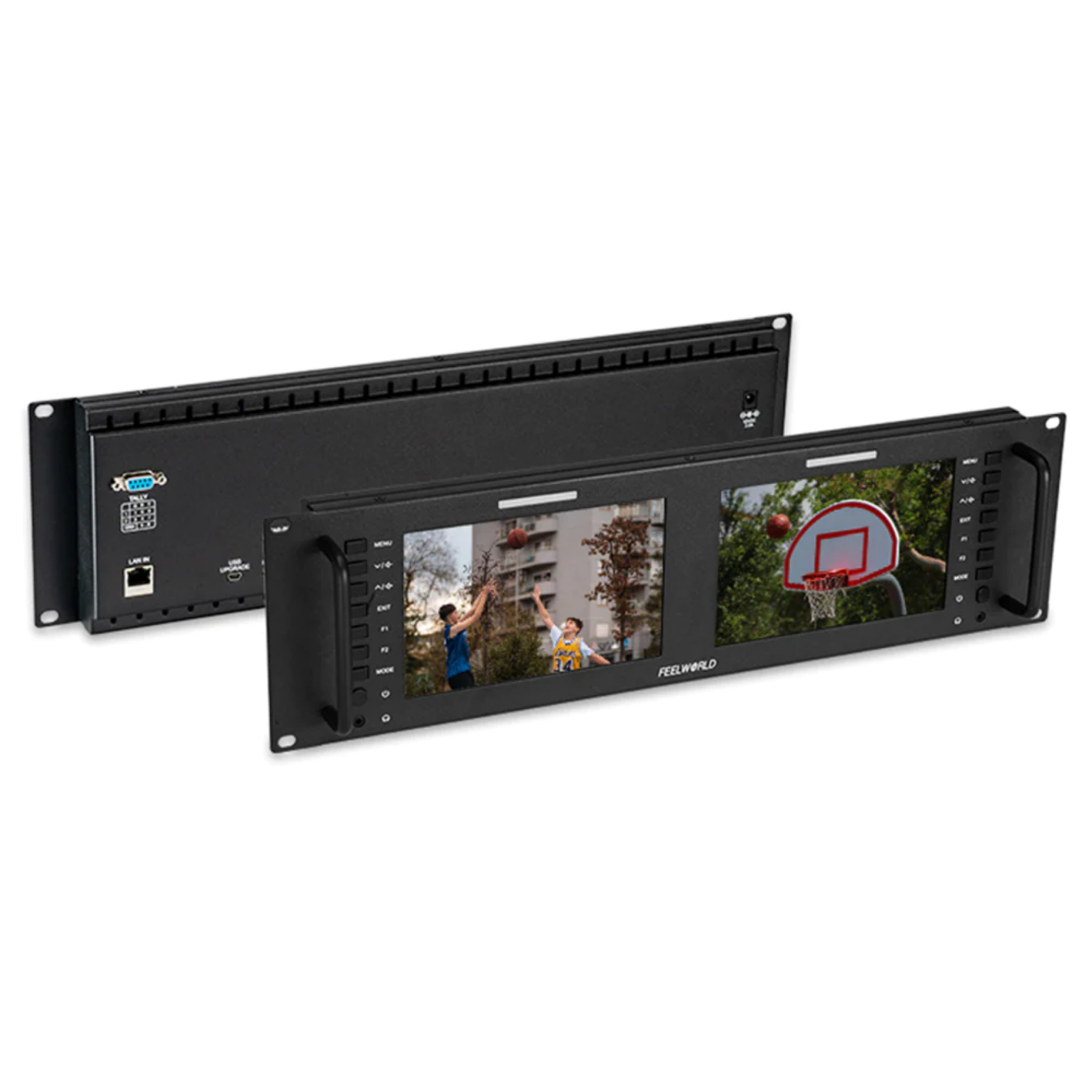
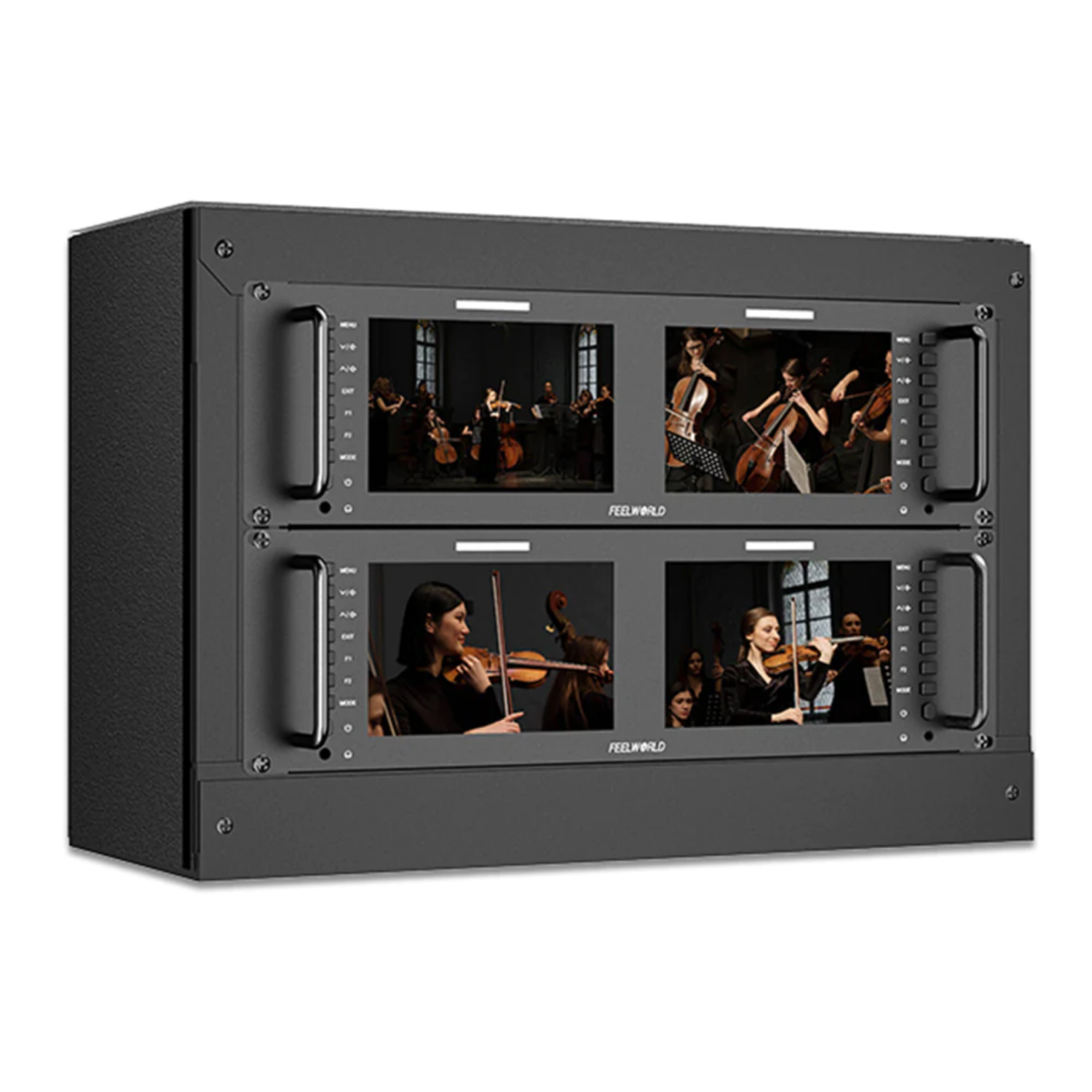
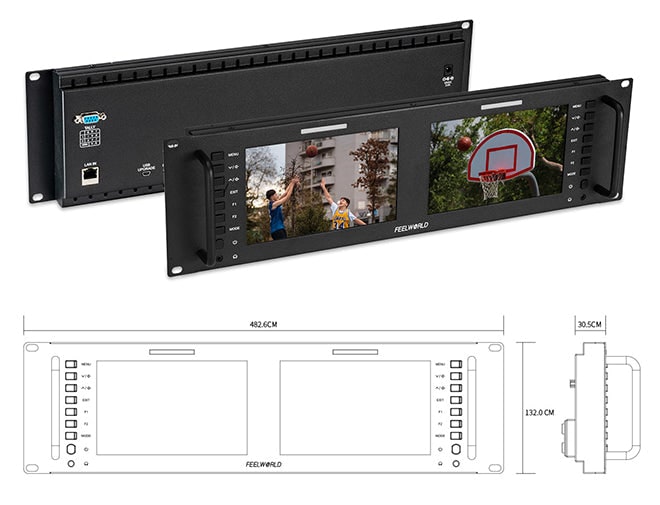
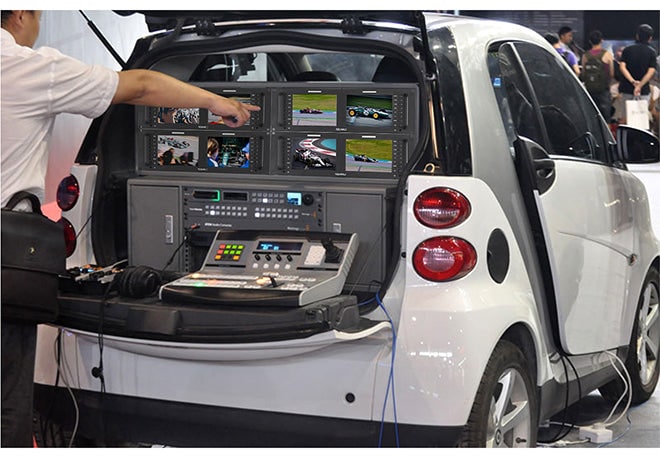
The D71 PLUS-H is not an on-camera monitor — it is a rack panel for a video wall, an edit suite or an OB van. Two seven-inch IPS displays sit in a metal body measuring 482.6 × 132 × 30.5 mm, each with its own input, its own row of buttons and its own settings. Two screens let you watch two different cameras at the same time.
The installation height is 3U, so the panel bolts into any standard nineteen-inch frame. A weight of 1890 grams and a depth of just 30.5 millimetres matter when you are building a mobile gallery: in a truck every centimetre of space and every watt of heat counts.
A Full HD 1920 × 1200 panel
450 cd/m², 1100:1 contrast, 160° viewing angles
Each of the two IPS panels runs 1920 × 1200 pixels in a 16:10 aspect ratio with a dot pitch of 0.07875 millimetres. Colour reproduction is faithful and fine detail stays legible.
A brightness of 450 cd/m² and a contrast ratio of 1100:1 place this monitor indoors — in a studio, an edit suite or a truck. It is not made for direct sunlight and the manufacturer does not sell it as such. Viewing angles are 80° to each side, that is 160° horizontally and vertically: the picture holds its colour even when you look at it from the side or from above.
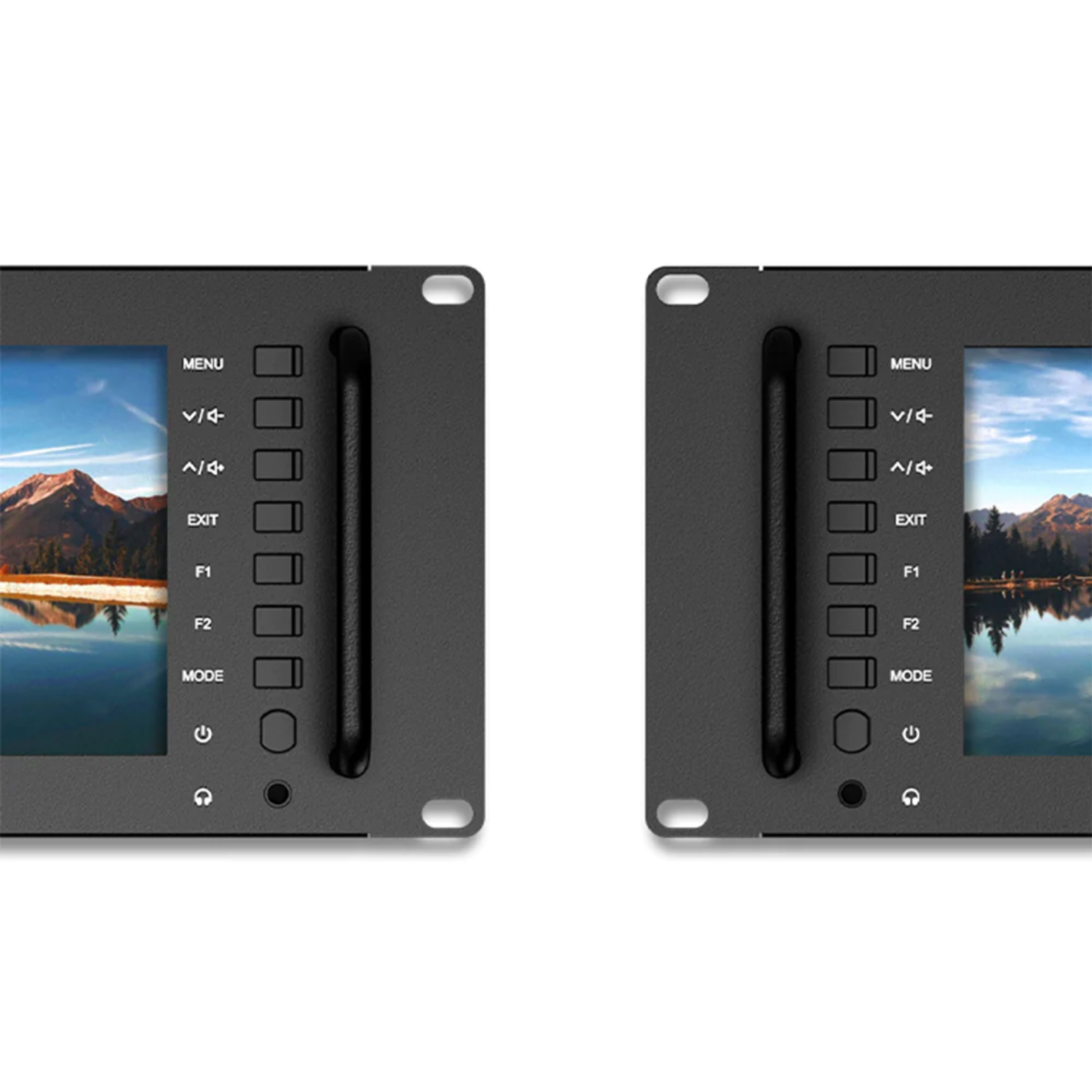
Separate buttons for each screen, and a three-colour tally
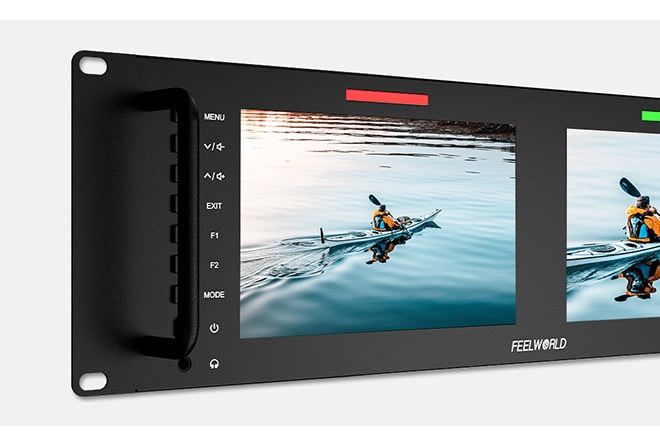
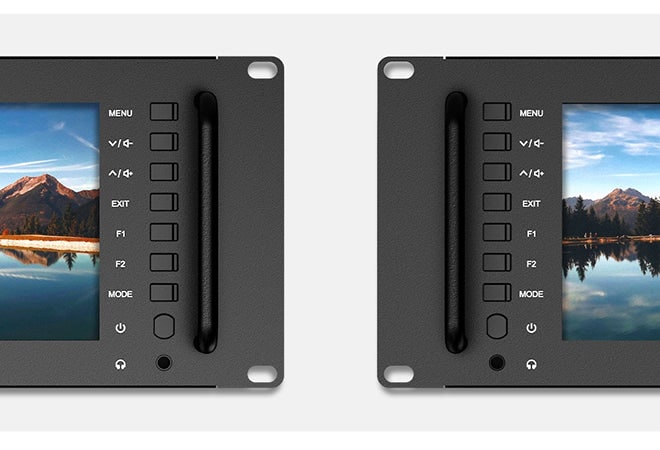
Each display has its own row of buttons on the front panel: MENU, a pair of arrows doubling as volume, EXIT, programmable F1 and F2, MODE and a power key. The F key is a shortcut to the functions you reach for most, so you do not have to walk through menus while the show is running.
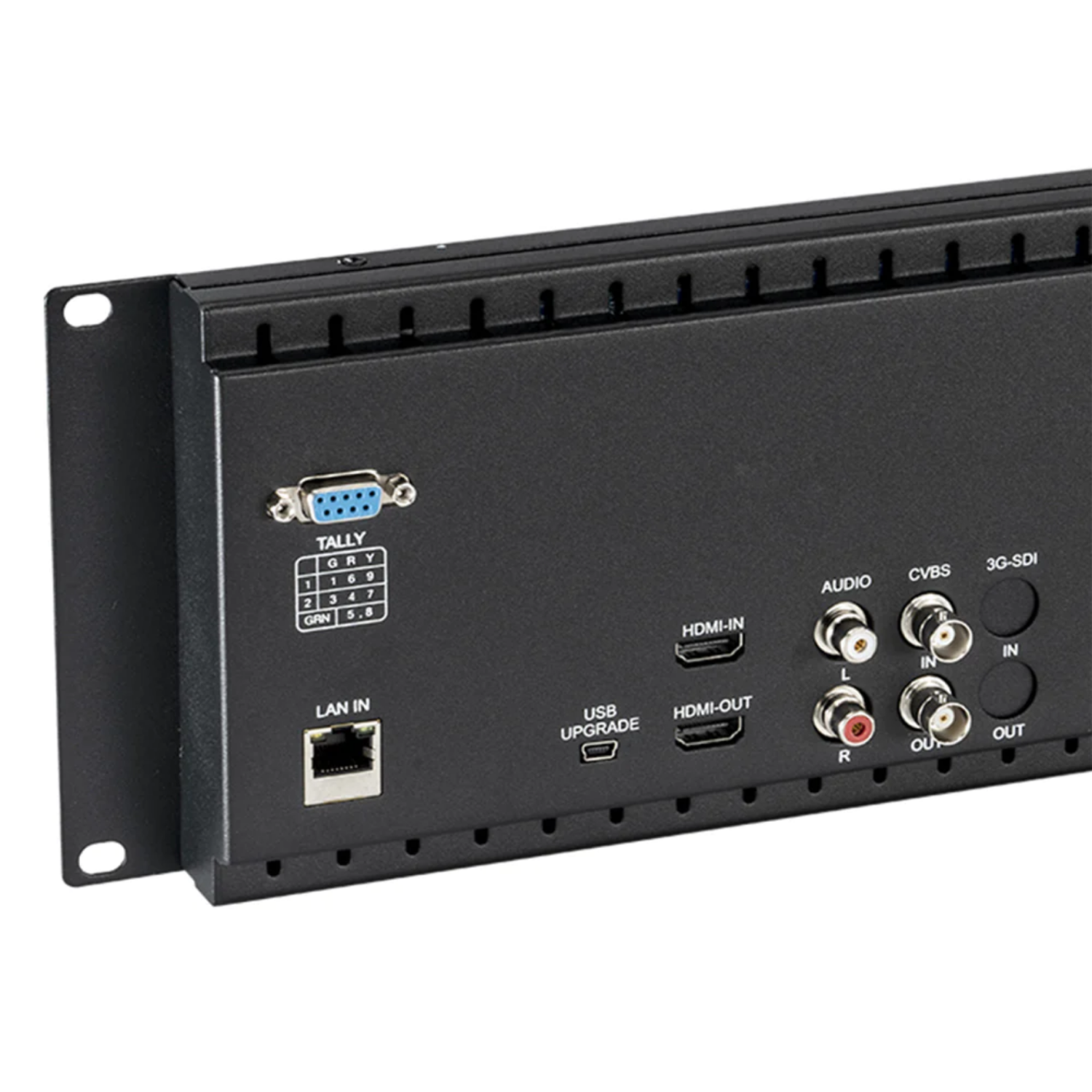
Each screen also has its own tally strip in three colours — red, green and yellow. It is driven from the DB-9 port on the back, so whoever sits at the monitor knows which camera is on air and which is standing by, just as the gallery does.
Inputs and outputs for each display separately
HDMI and composite video only — this variant is HDMI-only
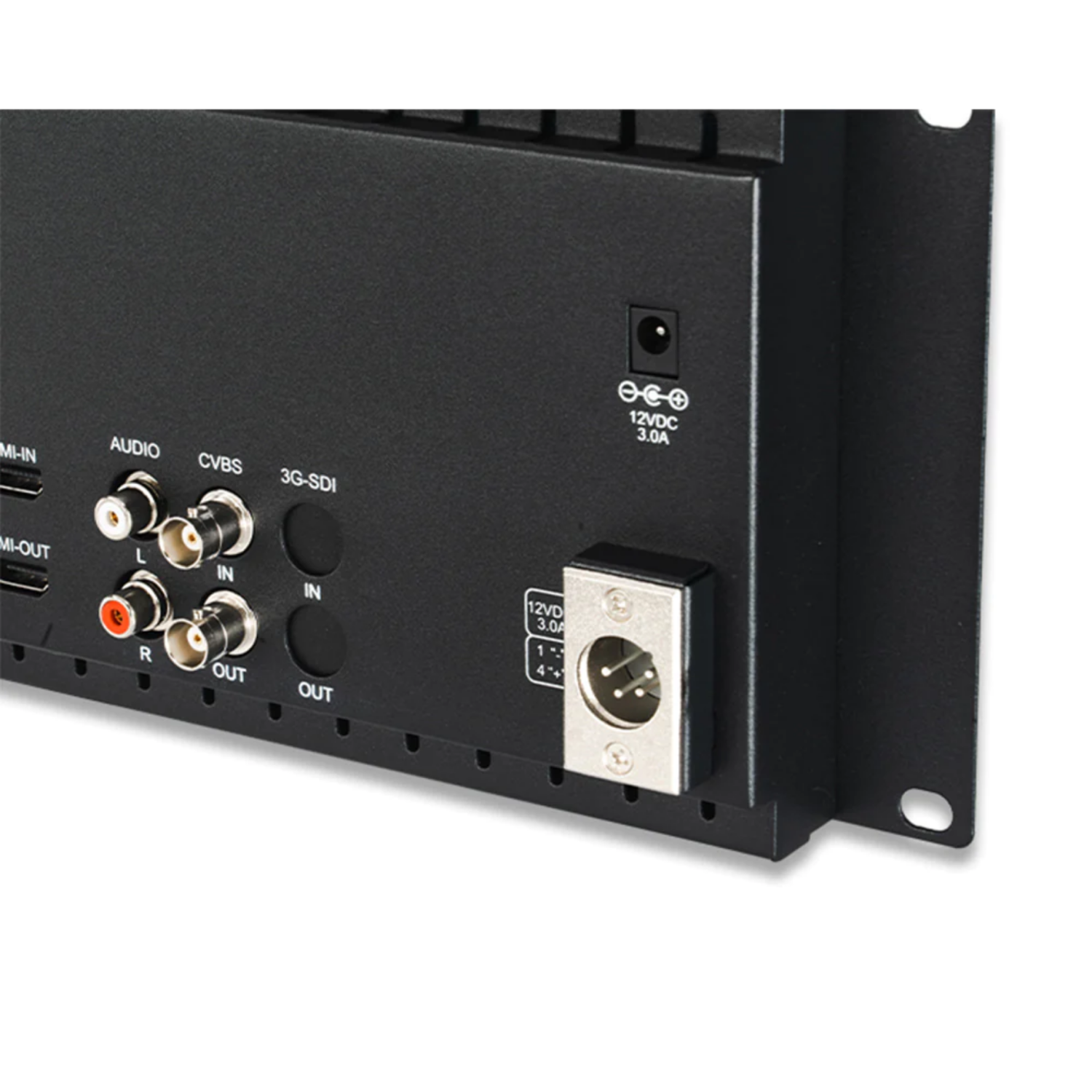
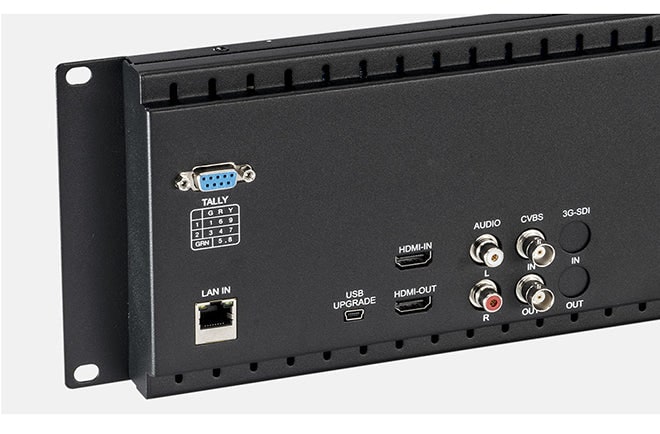
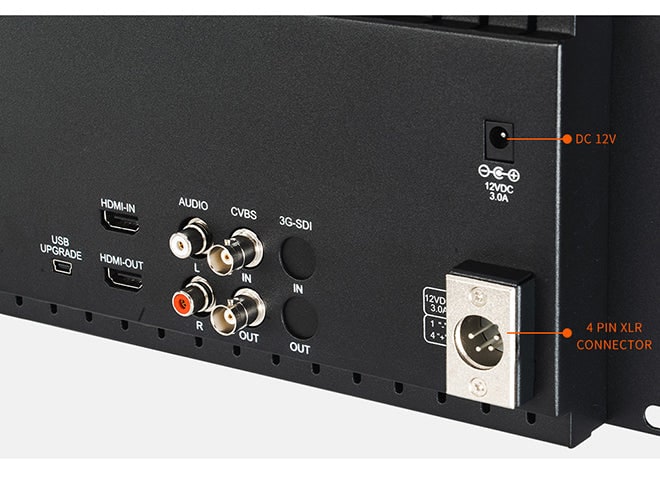
The rear panel carries HDMI in and out and composite video (CVBS) in and out on BNC for each of the two displays. Alongside them sit a pair of RCA inputs for L/R audio and a stereo headphone output.
The HDMI input accepts 4K UHD 3840 × 2160 up to 30 Hz and DCI 4K 4096 × 2160 at 24 Hz, plus 1080p up to 60 frames, 1080i, 720p and standard definition 480i/576i/480p/576p. The composite input recognises PAL and NTSC on its own.
On the photographs of the rear panel you will notice the silkscreen 3G-SDI IN and 3G-SDI OUT: the chassis is shared with the D71 PLUS, but on the -H variant those markings sit above blanked holes and no connectors are fitted. If you need SDI, the model to buy is the D71 PLUS.
Inputs and outputs are doubled up, so the panel drops into a chain: the signal passes through to the next monitor, to a recorder or to the gallery without a separate distribution amplifier. Power comes in on a DC 12 V barrel jack or a four-pin XLR, both accepting 9 to 24 V.
Setting up over the network instead of by button
A LAN socket sits next to the video connectors. Once it is on the network the panel announces its IP address and can be set up from a computer with the GPIO software the manufacturer offers for download. After logging in you add the monitor by its IP address and then switch inputs and change brightness, contrast, saturation, sharpness and backlight from the keyboard — for each of the two screens separately (0 is the left one, 1 is the right one).
In a wall five or ten panels high that is the difference between a minute and half an hour on a ladder. A note from the manufacturer: the software runs on Windows.
The USB connector on the back is used for firmware updates and for loading custom LUT files from a flash drive.
3D LUT and tools for checking the picture
Up to 32 custom .cube tables from a flash drive
A log-to-Rec.709 conversion is built in, and alongside it the panel loads up to 32 custom .cube tables. The files go into the root directory of a USB flash drive and are imported through an adapter into the USB connector on the back. That puts the target look in front of you while you are still shooting, not once you are in the edit.
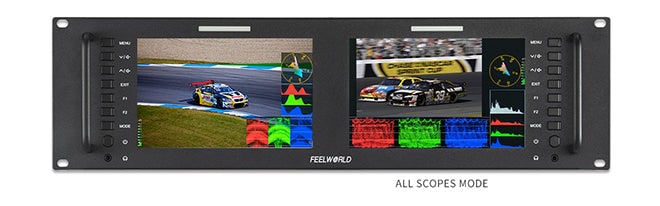
The tool set covers waveform (RGB parade, YUV parade, Y parade), vector scope, luminance and RGB histograms, audio phase and level, focus peaking, zebra, false colour, zoom, pixel to pixel, frame guides and a nine grid. The scopes open one at a time or all at once with a single key in All Scopes mode — at which point they stand in for a separate and far more expensive rasteriser.
The two screens are set up independently, so one can show a clean picture while the other analyses the signal from the same camera.
Where it earns its place
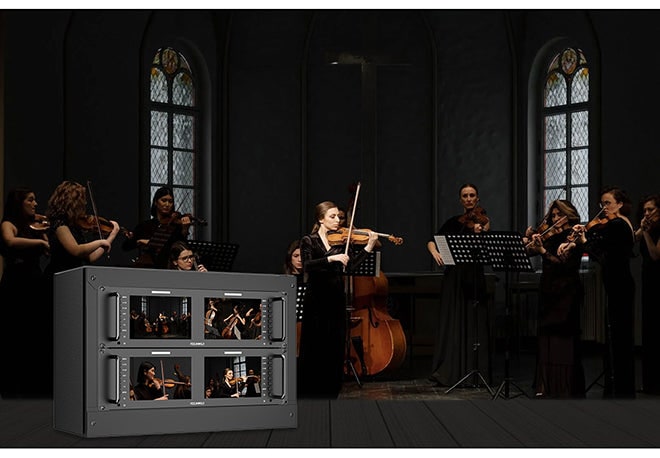
In a broadcast gallery the panels stack on top of each other and cover many camera inputs at once; the built-in tally keeps showing what is on air and what is recording.
In a mobile OB truck it comes down to space and heat. The D71 PLUS-H is shallow, light and draws no more than 21 W, so it fits a frame where a deeper monitor would be in the way. Beyond broadcast it suits post-production, on-set monitoring, concert coverage and flyaway kits that travel by air.
PACKAGE CONTENT
- D71 PLUS-H rack mount monitor
- 3 A power adapter
- Tally kit
- Operation manual
SPECIFICATIONS
- Model: D71 PLUS-H
- Description: dual 7" 3RU rack mount monitor with waveform and 3D LUT, HDMI only
- Screen size: 7" × 2 IPS
- Resolution: 1920 × 1200 pixels per display
- Dot pitch: 0.07875 × 0.07875 mm
- Aspect ratio: 16:10
- Brightness: 450 cd/m²
- Contrast ratio: 1100:1
- Backlight: LED
- Viewing angle: 80°/80° (L/R), 80°/80° (U/D)
- Inputs (each LCD): 1× HDMI, 1× BNC composite video (CVBS), 2× RCA audio L/R
- Outputs (each LCD): 1× HDMI, 1× BNC composite video (CVBS)
- Audio out: stereo headphone × 1 per display
- HDMI support format: 480i/576i/480p/576p · 1080i (60/59.94/50) · 720p (60/59.94/50/30/29/25/24/23.98) · 1080p (60/59.94/50/30/29.97/25/24/24sF/23.98/23.98sF) · 4K UHD 3840 × 2160p (30/29.97/25/24/23.98 Hz) · DCI 4K 4096 × 2160p (24 Hz)
- CVBS support format: PAL/NTSC auto recognise
- Tally: front indicator for each screen, three colours (red, green, yellow), controlled over DB-9
- Remote control: Ethernet (LAN) via the GPIO software, listed by the manufacturer for Windows
- 3D LUT: built-in LOG to Rec.709, up to 32 custom .cube tables from a USB flash drive
- Video assist: waveform (RGB/YUV/Y parade), vector scope, histogram, audio phase and level, focus peaking, zebra, false colour, zoom, pixel to pixel, frame guides, nine grid, All Scopes mode
- Other interfaces: 1× LAN, 1× USB (firmware update and LUT loading), 1× DB-9 (tally)
- Input voltage: DC 9–24 V
- Power connector: DC barrel jack and 4-pin XLR (a 12 V / 3 A adapter is included)
- Power consumption: ≤ 21 W
- Install way: rack mount, 3RU installation height
- Working temperature: −10 °C to 60 °C
- Storage temperature: −30 °C to 70 °C
- Unit size: 482.6 × 132 × 30.5 mm (W × H × D)
- Unit weight: 1890 g
WE RECOMMEND
The following accessories go with the Feelworld D71 PLUS-H. They are picked according to the connectors and power supply the product actually has.
HDMI cables – Full-size HDMI cables (type A on both ends) from 0.8 to 10 metres for linking the panel to a switcher, a camera or a player.
Parameters
| Manufacturer: | Feelworld |
| Category: | Studio Monitors |
Main parameters
| Size | 7" |
| Monitor inputs | HDMI · 4K HDMI · Composite Video |
| Luminosity | 450cd/m2 |
| Panel resolution | 1920x1200 |
| Monitor power supply | 12V XLR · 12V |
Other parameters
| Other features | rack · Tally · 3D LUT correction |
GPSR
TB EC REP EUROPEAN SL
Business address: Calle Marcelo Usera 60, LC. Madrid 28026 Spain
ACCESSORIES (4)
ACCESSORIES (4)
SmallRig Ultra-Slim 4K HDMI Data Cable (A to A) (100cm) 4794
An ultra-slim HDMI 2.0 data cable, A to A, 100 cm long and just 3.6 mm across. It
13 €
In stock > 5 pcs
Infinitek HDMI TO HDMI ultra thin flixible 4K cable, 80cm
Promotion: -20%
Infinitec ultra tenký a flexibilný 4K HDMI v 2,0 kábel pre kreatívnych profesionálov.
18.48 €
22.99 €
In stock > 5 pcs
HDMI cable 2.0 UHD 4K High Speed + Ethernet 10m
Propojovací HDMI 2,0 kabel UHD 4K High Speed + Ethernet kabel s integrovaným zes
48 €
In stock 2 pcs
HDMI cable 2.0b UHD 4K High Speed + Ethernet 3,0m
Propojovací HDMI 2,0b kabel UHD 4K High Speed + Ethernet kabel
9.3 €
To be sent 2 pcs
Alternative (6)
Alternative (6)
Lilliput TK2700/T
The Lilliput TK2700/T is a 27-inch industrial-grade metal-bezel monitor with 1000-nit
479 €
on request
Feelworld D71 PLUS Dual 7"3RU Rack Mount Monitor 4K HDMI SDI
A dual seven-inch rack monitor with a 3U installation height for the broadcast gallery,
739 €
Backordered 1 pcs
Lilliput TK1560/T - 15.6" HDMI Customisable Touch Monitor
The TK1560/T Touch monitor is a 15.6" HDMI monitor - a bigger brother to the Lilliput
439 €
14-30 days
Lilliput TK2150/C 21.5 inch non-touch screen monitor
Designed for HMI applications, the 21.5" Full HD Industrial Display from Lilliput
479 €
14-30 days
Lilliput TK-1850/T
The Lilliput TK1850/T is an 18.5" Full HD (1920x1080) industrial touchscreen monitor
459 €
on request
ATEM156 - multiview monitor
Multiview monitor with pass-through HDMI I/O suitable for HDMI overheads such as
609 €
on request
News, training, and discounts from Syntex
Special offers and discounts for subscribers only · Free audio & video workshops · News and tips from the world of filmmaking
- Show all
Feelworld D71 PLUS-H
A dual seven-inch rack monitor with a 3U installation height for the broadcast gallery,479 €on request