
 CZ
 SK
 HU
 AT
 DE
 ES
 SI
 HR

Nothing in the basket.

- Search
-
Login

-
0
Comparison
Add products to compare, then they will appear here and you can compare parameters.
-
0
0 €
Advice
Sony NP-FZ100 Battery: Compatible Cameras and Chargers
The Sony NP-FZ100 powers the Alpha 7 III to 7 V, 7R, 7S III, 7C, Alpha 9, Alpha 1, 6600/6700 and the FX3, FX30 and ZV-E1. We advise you on which original or third-party battery and charger to choose.
Battery guide
Sony NP-FZ100 Battery

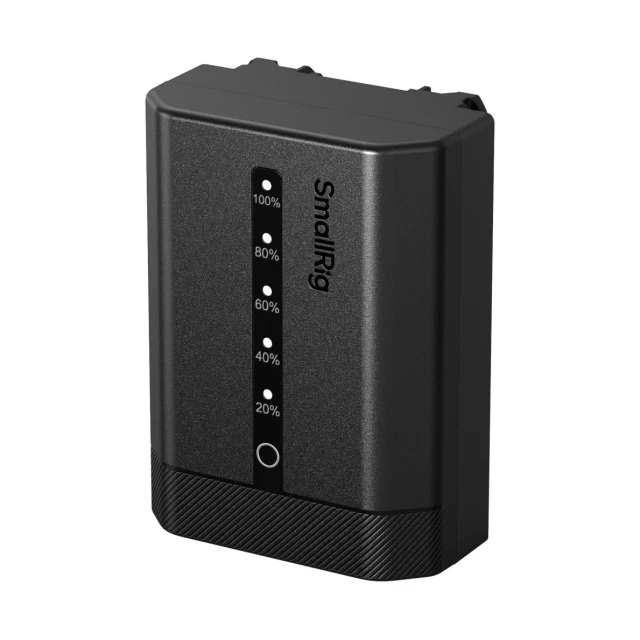

Which cameras and camcorders use the NP-FZ100
Sony introduced the NP-FZ100 (InfoLithium Z series) in 2017 with the Alpha 9, and since then it has been used by most full-frame Alpha bodies and some APS-C models. You can't fit it into older cameras that use the NP-FW50 battery – it is larger and has a different shape.
| Manufacturer | Model | Note |
|---|---|---|
| Sony | Alpha 9, Alpha 9 II, Alpha 9 III | professional sports series |
| Sony | Alpha 1, Alpha 1 II | |
| Sony | Alpha 7 III, Alpha 7 IV, Alpha 7 V | |
| Sony | Alpha 7R III, 7R IIIA, 7R IV, 7R IVA, 7R V | the "A" versions use the same battery as the base model |
| Sony | Alpha 7S III | |
| Sony | Alpha 7C, Alpha 7C II, Alpha 7CR | compact full-frame bodies |
| Sony | Alpha 6600, Alpha 6700 | APS-C; the other 6000-series models use the NP-FW50 |
| Sony | ZV-E1, ZV-E10 II | the original ZV-E10 uses the NP-FW50 |
| Sony | FX2, FX3, FX30 | Cinema Line |
| Sony | VG-C3EM, VG-C4EM, VG-C5 battery grips | hold two NP-FZ100 batteries; check separately which body the grip fits |
Sony also lists the NP-FZ100 for other and newer models. If you can't find your body in the table, check the battery type in the manual or on the underside of the battery you have. What matters is the exact designation "NP-FZ100", not a similar-sounding name.
NP-FZ100 battery variants
Unlike Canon (LP-E6 / LP-E6N / LP-E6NH / LP-E6P) or Nikon (EN-EL15 to EN-EL15c), Sony has only one original version in this system – the NP-FZ100. The original battery has a nominal voltage of 7.2 V and a capacity of 2280 mAh (16.4 Wh). So there is no generation you need to watch out for.
The differences are found among third-party batteries:
| Type | What it offers | What to watch out for |
|---|---|---|
| Original Sony NP-FZ100 | full communication with the camera (percentage, time estimate), proven compatibility | higher price, charging only in the body or in a charger |
| Alternative without USB-C | lower price, often in a set with a charger | capacity according to the manufacturer, cell quality varies |
| Alternative with USB-C on the battery | charge it with a cable, without a charger or the body | the port is usually on the side that sits inside the camera – it only charges when removed |
| Alternative with a status display | you can see the remaining capacity even outside the body | the display and electronics take up space – capacity tends to be similar |
Original or third-party battery?
Sony NP-FZ100 (NPFZ100.CE) is the safe choice if you want to be sure the camera correctly shows the remaining capacity and doesn't display warnings. For professional work, where a battery failure costs more than the battery itself, it is a sensible foundation.
Third-party batteries from established accessory makers work without problems in most bodies and cost a fraction of the price. In fairness, though, it must be said:
- The status indicator may not be as accurate as with the original, and with some combinations of body and firmware an incompatible battery message may appear.
- The capacity stated in the name (2280, 2400, 2600 mAh) is the battery manufacturer's figure; the actual runtime may differ.
- After a camera firmware update, the behaviour of a non-original battery may change. If the battery matters (a paid shoot), test it in advance.
From our range:
SmallRig 4265Bbattery with USB-C charging right in the battery housing.
SmallRig 5297USB-C and a display showing the remaining capacity.
Tilta TNP-FZ100-GN2400 mAh with USB-C input.
FALCAM TagBatt TB0A5801with direct charging.
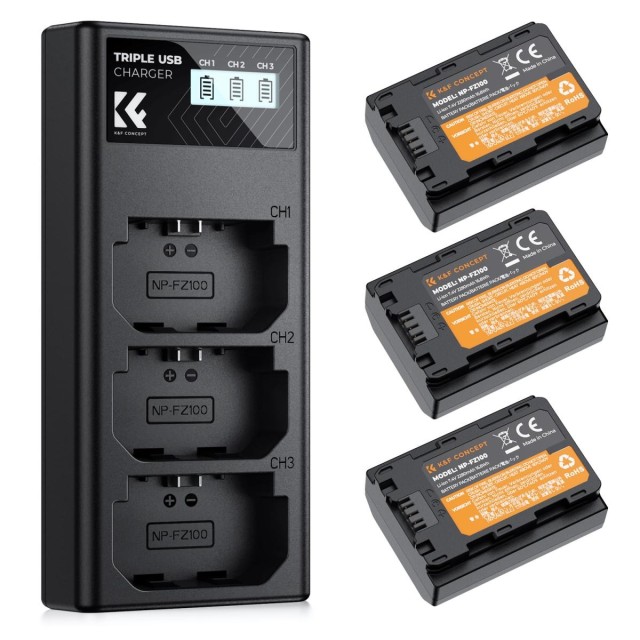
K&F Concept KF28.0038three 2280 mAh batteries and a 3-slot charger, good value for video.

SmallRig 6016battery set for the NP-FZ100.
Chargers and charging cases
Most bodies using the NP-FZ100 can be charged via USB directly in the camera, and newer models can also be powered via USB-C. However, in-body charging is slow and you can't use the camera while it charges, so a separate charger is worth it.
Original:Sony BC-QZ1 (BCQZ1.CEE) – Sony single-slot charger.
Two slots:SmallRig 5489, K&F Concept KF28.0058 or K&F Concept KF2802.0202.0030 with a USB-C PD input.
Four slots:SmallRig 4839 or Tilta TBC-FZ100-GN – for shooting with a larger number of batteries.
Charging cases:SmallRig 5106, SmallRig 5109 (doubles as a power bank) or ZGCINE PS-FZ100 – your batteries are stored safely in the field and recharged via USB-C at the same time.
For long recordings on a tripod, consider a dummy battery powered via USB-C or D-Tap instead of batteries, such as the SmallRig 4269B with an AC adapter.
With USB-C input chargers, check what adapter output they require – with a weak phone charger they charge slowly or not at all.
How many batteries you need
The NP-FZ100 is one of the longer-lasting batteries in mirrorless cameras. For ordinary photography, one battery in the body and one spare are enough for most people. Video consumption is much higher – stabilisation, 4K, longer recordings and an active screen or viewfinder drain the battery faster. For a full day of filming, plan on three to four batteries and a charger, ideally a multi-channel one. In winter, capacity drops noticeably; carry spare batteries in a pocket close to your body.
Care, storage and air travel
- Store batteries you won't use for a while charged to about half, and top them up once every few months.
- Don't leave them in a hot car and don't charge them when they are frozen – let them warm up to room temperature first.
- Stop using a swollen or damaged battery and take it to a collection point.
The NP-FZ100 has 16.4 Wh, well below the 100 Wh limit. Spare batteries belong in your hand luggage, not in checked baggage.
Frequently asked questions
Is the NP-FZ100 the same as the NP-FW50?
No. The NP-FW50 is a smaller, weaker battery for the older Alpha 6000–6500, Alpha 7 / 7 II and ZV-E10. They are not physically interchangeable.
Do non-original batteries work in the Sony Alpha 7 IV or FX3?
Good-quality alternatives usually do, but the remaining-capacity display may be less accurate and the behaviour may change after a firmware update. Test the battery before an important shoot.
Can I charge the battery in the camera?
On most models, yes, via a USB cable. The speed and the option of powering the camera at the same time depend on the body model and the adapter's output – check the camera manual.
Why do alternatives have more mAh than the original?
The capacity is stated by the battery manufacturer and may not be measured the same way as by Sony. A higher number on the label doesn't automatically mean longer runtime.
Do non-original batteries fit a Sony grip?
Usually yes, the dimensions are the same. However, the shape varies slightly between manufacturers, and if the battery has a USB-C port or a display, check that it doesn't get in the way in the grip's battery compartment.