
 CZ
 SK
 HU
 AT
 DE
 ES
 SI
 HR

Nothing in the basket.

- Search
-
Login

-
0
Comparison
Add products to compare, then they will appear here and you can compare parameters.
-
0
0 €
Advice
Nikon EN-EL15c Battery: Compatible Cameras and Chargers
The Nikon EN-EL15c and older EN-EL15, 15a and 15b power the Z5, Z6, Z7, Z8 and Z f as well as the D7500, D750 and D850. We explain the generations, when the battery can be charged via USB in the camera and which spare battery and charger to choose.
Battery guide
Nikon EN-EL15c Battery
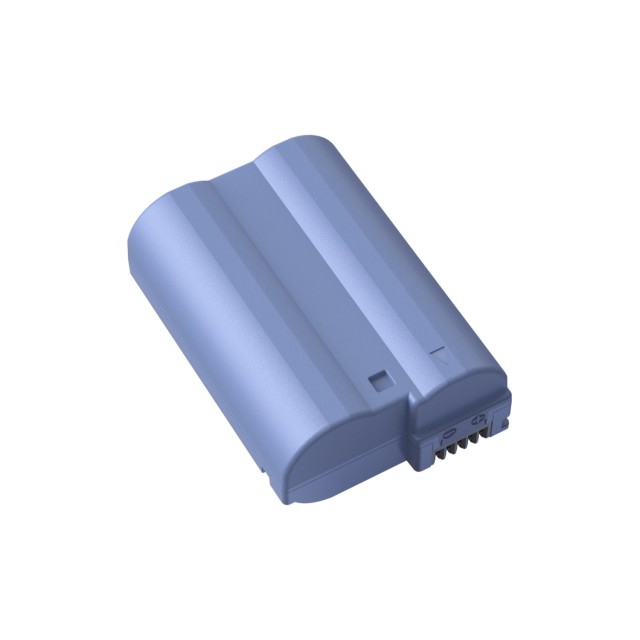
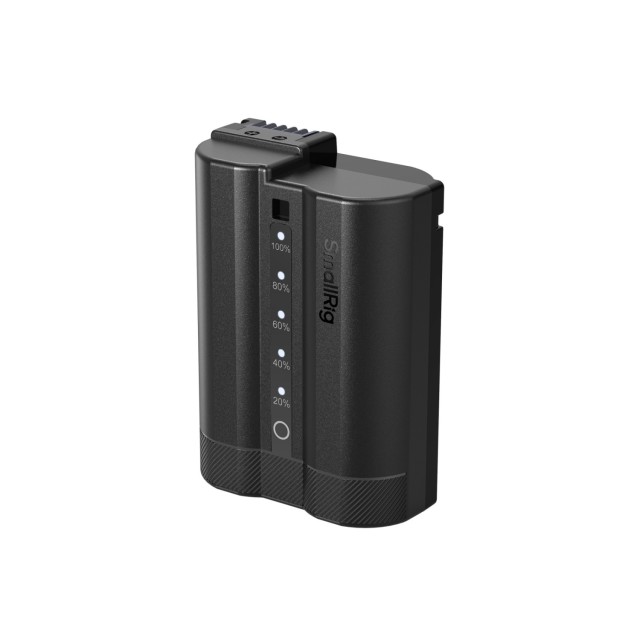

Which cameras use the EN-EL15 battery
The EN-EL15 family has been Nikon's most widespread battery for the last fifteen years. It is used by the full-frame Z-series mirrorless cameras and most mid-range and professional DSLRs. The table lists models for which the battery type is unambiguous. If you can't find your camera, check the type in the manual or directly on the label of the battery in your body.
| Manufacturer | Model | Note |
|---|---|---|
| Nikon | Z5, Z6, Z7 | first-generation mirrorless; USB charging only with EN-EL15b/15c |
| Nikon | Z6 II, Z7 II | USB-C charging and power with EN-EL15b/15c |
| Nikon | Z6 III | supplied with EN-EL15c |
| Nikon | Z5 II, Z5IIc | supplied with EN-EL15c |
| Nikon | Z8 | supplied with EN-EL15c |
| Nikon | Z f | supplied with EN-EL15c |
| Nikon | ZR | Z-series video camera, supplied with EN-EL15c |
| Nikon | D7000, D7100, D7200, D7500 | APS-C (DX) DSLRs |
| Nikon | D500 | professional DX DSLR |
| Nikon | D600, D610 | full-frame DSLRs |
| Nikon | D750, D780 | full-frame DSLRs |
| Nikon | D800, D800E, D810, D850 | high-resolution full-frame DSLRs |
The same battery type is also used by the battery grips for these bodies (the MB-D and MB-N series) and by a range of third-party accessories, such as power adapters for monitors. Note: the Nikon D3100–D3500, D5100–D5600 and Df use the smaller EN-EL14/EN-EL14a battery, the Z50, Z50 II, Z fc and Z30 use the EN-EL25 and the Z9 uses the EN-EL18. These are not interchangeable with the EN-EL15.
EN-EL15, EN-EL15a, EN-EL15b and EN-EL15c battery variants
All four generations have the same shape and contacts, so they physically fit all the bodies listed above. They differ in capacity and in whether they can be charged directly in the camera via USB.
| Battery | Voltage / capacity | In-camera USB charging | Note |
|---|---|---|---|
| EN-EL15 | 7.0 V / 1900 mAh | no | original version (D7000, D800) |
| EN-EL15a | 7.0 V / 1900 mAh | no | improved cells, same use as EN-EL15 |
| EN-EL15b | 7.0 V / 1900 mAh | yes (on supported bodies) | introduced with the Z6 and Z7 |
| EN-EL15c | 7.0 V / 2280 mAh (16 Wh) | yes (on supported bodies) | current version, supplied with the Z6 III, Z8, Z f, Z5 II |
Backward compatibility: you can use the newer batteries (15a, 15b, 15c) in older bodies designed for the EN-EL15. The reverse is only partly true – the newest bodies (e.g. Z8, Z6 III) accept the EN-EL15a and EN-EL15b with fewer shots per charge, but Nikon does not list the original EN-EL15 without a suffix among their usable batteries. You will find the exact conditions for your model in the manual, in the chapter on compatible batteries.
When the version really matters:
In-camera USB charging.Z-series mirrorless cameras can charge the battery directly in the body from a USB adapter or power bank – but only the EN-EL15b and EN-EL15c. If you insert an EN-EL15 or EN-EL15a, the camera will not charge it via USB and you have to put the battery in an external charger.
USB power during operation.On models that support it (for example the Z6 II, Z7 II, Z8), a 15b/15c battery is also required. For long recordings, however, a dummy battery is more reliable (see below).
Runtime.The difference between 1900 mAh (EN-EL15/15a/15b) and 2280 mAh (EN-EL15c) is about one fifth – noticeable when recording video.
Original or third-party battery?
The original Nikon EN-EL15c (VFB12802) is the safest choice: the camera fully recognises it, shows the exact charge level and the battery's "age" in the Battery info menu, and there is no risk of future firmware rejecting it. The downsides are a higher price and the fact that it can only be charged in the body or in a charger – it has no USB-C port of its own.
Third-party batteries from accessory makers are usually sold as "EN-EL15c" and additionally have a USB-C port right in the battery housing. You can charge them from your phone cable without a charger, which is handy when travelling. From our range:
SmallRig 4332B(and the orange variant SmallRig 4966) – battery with USB-C charging.
SmallRig 5299with USB-C and a charge level indicator right on the battery.
Tilta TEN-EL15C-GN2400 mAh, USB-C input.
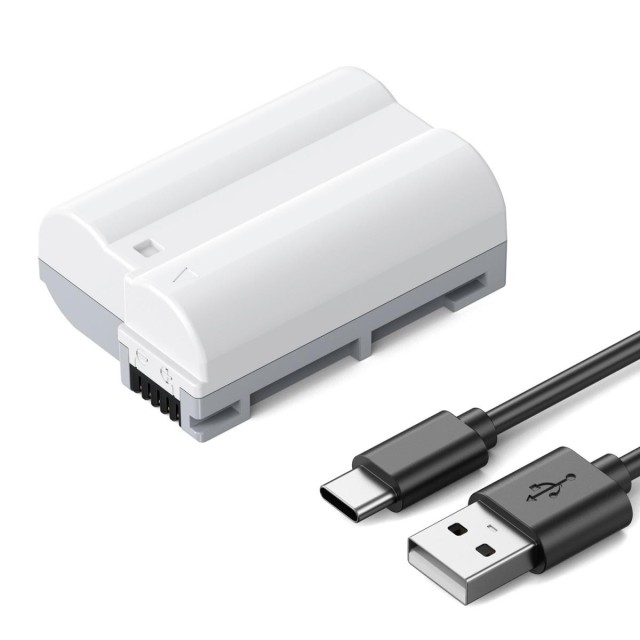
K&F Concept KF28.00412600 mAh, USB-C.
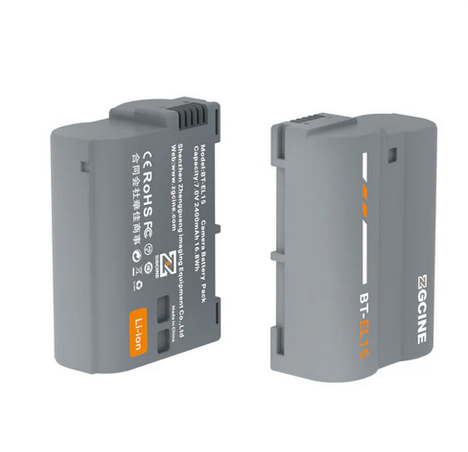
What to watch out for: the capacity stated by third-party makers is measured differently than for the original, and in practice the difference in runtime tends to be smaller than the numbers suggest. With non-original batteries the camera may not display all information (such as the wear level), and in rare cases new firmware may change how the camera treats third-party batteries. If you shoot paid jobs, we recommend keeping at least one original battery in your bag as a backup.
For older DSLRs, where in-camera charging plays no role, a cheaper battery without USB-C will do, such as the K&F Concept KF28.0012 set (2× EN-EL15 2100 mAh + charger).
Chargers and charging cases
Original Nikon chargers.The Nikon MH-25a (VEA016EA) charges all EN-EL15 versions. The newer Nikon MH-34 (VEA02602) is powered via USB-C and is designed for the EN-EL15b and EN-EL15c. Both are currently out of stock; check availability on the product page.
Dual-channel chargers.SmallRig 5491 or K&F Concept KF2802.0202.0070 with a display and a 20 W USB-C PD input.
Four-channel chargers.SmallRig 5747 and Tilta TBC-EL15-GN – for those who rotate several batteries or several bodies.
Charging cases.SmallRig 5107, ZGCINE PS-EL15 or SmallRig 5110 (a case that doubles as a power bank). The batteries are protected in transit and you can charge them via USB-C.
Battery + charger kits.Tilta TBC-EL15C-A-GN (2 batteries) and TBC-EL15C-B-GN (4 batteries), SmallRig 6018, SmallRig 5486 or K&F Concept KF28.0145 (3× 2520 mAh).
For long recordings on a tripod or gimbal, consider a dummy battery that powers the camera from an external source: SmallRig 6541 (from a USB-C power bank), SmallRig 6537 or ZGCINE DT-EL15 (from the D-Tap output of a V-mount battery) and ZGCINE PD-EL15.
How many batteries you need
For ordinary shooting on a trip, one battery in the body and one spare are usually enough. DSLRs with an optical viewfinder last much longer on a single charge than mirrorless cameras, which continuously power an electronic viewfinder or screen.
When recording 4K video with stabilisation active and the screen on, the battery drains faster. For a full day of filming (a wedding, an event, a reportage), plan on three to four batteries, or power from a power bank or a dummy battery. In winter, add one extra battery, as the cold temporarily reduces capacity.
Care, storage and air travel
Lithium-ion batteries are best stored at about half charge (approximately 50 %) in a dry place at room temperature. If you don't use a battery for several months, top it up occasionally so that it doesn't discharge completely. Don't leave it in a hot car or in direct sunlight, and don't charge it right after bringing it in from the freezing cold – let it warm up to room temperature first.
In winter, carry spare batteries in a pocket close to your body, not in your backpack. A cold battery shows a lower charge level and the camera may switch off sooner, but some of the capacity "comes back" once it warms up. Stop using batteries with a visibly swollen or damaged casing and take them to a collection point.
A capacity of roughly 14–16 Wh (EN-EL15c: 16 Wh) is well below the 100 Wh limit, so you can take spare batteries on a plane in your hand luggage without special approval. Loose lithium batteries do not belong in checked baggage. Protect the contacts with a cover or carry the batteries in a charging case or separate pouches. If a charging case has a built-in power bank, the same rules apply to it – it belongs in your hand luggage.
Frequently asked questions
Can I use an older EN-EL15 battery in the Nikon Z6 III or Z8?
Not the original EN-EL15 without a suffix – Nikon does not list it among the usable batteries for the Z6 III or Z8. The EN-EL15a and EN-EL15b can be used, but they give fewer shots per charge, and the EN-EL15a cannot be charged in the camera via USB. For full functionality, use the EN-EL15c.
Is the EN-EL15c suitable for an old D7000 or D800 DSLR?
Yes, the newer versions are backward compatible with DSLRs that use the EN-EL15. You get higher capacity than with the original battery; these DSLRs do not support in-camera USB charging, so you charge externally.
Why won't my battery charge in the camera via USB?
The most common reason is that you have an EN-EL15 or EN-EL15a in the body – these cannot be charged in the camera. Other reasons include an unsuitable adapter or cable (use a USB-C charger with Power Delivery support) or the camera being switched on – some models only charge when switched off.
Will the camera show the status of a non-original battery?
It will usually show the charge level, but may not display all the data from the Battery info menu (such as wear). That is why some alternatives have their own indicator right on the housing, for example the SmallRig 5299.
What is the right charger for the EN-EL15c?
The original MH-25a or MH-34, or a third-party charger that explicitly lists the EN-EL15c. Third-party batteries with a USB-C port can also be charged directly with a cable, without a charger.