
 CZ
 SK
 HU
 AT
 DE
 ES
 SI
 HR

Nothing in the basket.

- Search
-
Login

-
0
Comparison
Add products to compare, then they will appear here and you can compare parameters.
-
0
0 €
Advice
Canon LP-E6, LP-E6NH and LP-E6P: Compatibility and Chargers
The Canon LP-E6, LP-E6N, LP-E6NH and LP-E6P power the EOS R5, R6, R7, R, 5D, 6D, 7D, 90D and Blackmagic Pocket 4K/6K. We explain how the versions differ, when it matters and which batteries and chargers to choose.
Battery guide
Canon LP-E6, LP-E6NH and LP-E6P


Which cameras and camcorders use the LP-E6 battery
All LP-E6 versions have the same shape and contacts, so they physically fit all the devices in the table. They differ in capacity and in how much current the battery can deliver – see the next section.
| Manufacturer | Model | Note |
|---|---|---|
| Canon | EOS R5 Mark II | supplied with the LP-E6P; the camera works with the LP-E6NH/LP-E6N, but some functions may be restricted |
| Canon | EOS R6 Mark III | supplied with the LP-E6P |
| Canon | EOS C50 | Cinema EOS camera, uses the LP-E6P |
| Canon | EOS R5, EOS R5 C | supplied with the LP-E6NH |
| Canon | EOS R6, EOS R6 Mark II | supplied with the LP-E6NH |
| Canon | EOS R7 | supplied with the LP-E6NH |
| Canon | EOS R, EOS Ra | supplied with the LP-E6N |
| Canon | EOS 5D Mark II, 5D Mark III, 5D Mark IV | full-frame DSLRs |
| Canon | EOS 5DS, 5DS R | full-frame DSLRs |
| Canon | EOS 6D, 6D Mark II | full-frame DSLRs |
| Canon | EOS 7D, 7D Mark II | APS-C DSLRs |
| Canon | EOS 60D, 60Da, 70D, 80D, 90D | APS-C DSLRs |
| Blackmagic Design | Pocket Cinema Camera 4K, Pocket Cinema Camera 6K | LP-E6 type battery; the 6K G2 and 6K Pro models use a different type (NP-F570) |
LP-E6 type batteries are also often used in accessories – in field monitors, wireless video transmitters or lights with an LP-E6 battery mount. If you can't find your device in the table, check the battery type in the manual or on the label of the original battery.
LP-E6 battery variants: LP-E6, LP-E6N, LP-E6NH and LP-E6P
Canon has improved the battery several times over the years. All versions have a voltage of 7.2 V and are interchangeable in shape; they differ in capacity and capabilities.
| Version | Voltage | Capacity | Energy | What it brings |
|---|---|---|---|---|
| LP-E6 | 7.2 V | 1800 mAh | 13 Wh | original version (since the EOS 5D Mark II) |
| LP-E6N | 7.2 V | 1865 mAh | 14 Wh | slightly higher capacity |
| LP-E6NH | 7.2 V | 2130 mAh | 16 Wh | higher capacity, standard for the EOS R5, R6, R6 Mark II, R7 |
| LP-E6P | 7.2 V | 2130 mAh | 16 Wh | same capacity as the LP-E6NH, but a higher output current for the demanding modes of the EOS R5 Mark II |
Difference between the LP-E6NH and LP-E6P
The LP-E6P does not have a higher capacity than the LP-E6NH – both have 2130 mAh and 16 Wh. The difference lies in the current the battery can deliver. During its most demanding operations (fast burst shooting, high-resolution video), the EOS R5 Mark II draws more than the LP-E6NH is designed for. That is why the R5 Mark II ships with the LP-E6P and may restrict some functions with older versions. You will find the exact list of restrictions in the R5 Mark II manual.
The other way round works without problems: you can also use the LP-E6P in cameras that take the LP-E6NH. If you are buying new batteries and have (or plan to get) an R5 Mark II, it's worth going straight for the LP-E6P.
When the version matters
USB charging in the camera bodyThe oldest LP-E6 cannot be charged in the body. For cameras with USB charging (e.g. EOS R5, R6), plan on the LP-E6NH or LP-E6P.
Full performance of the EOS R5 Mark IIOnly with the LP-E6P.
RuntimeThe LP-E6NH and LP-E6P have roughly a fifth more energy than the original LP-E6. This is noticeable with mirrorless cameras, which consume more than DSLRs.
Status indicationOriginal batteries report the remaining capacity in percent and the state of wear to the camera (Battery info menu). With third-party batteries this applies only partially, see below.
Original or alternative battery?
Original Canon batteries are a safe bet: the camera shows the exact charge level and wear status, they support all functions including in-body charging, and there is no risk of warnings after a firmware update. The drawback is the higher price.
Alternative batteries from accessory makers tend to be cheaper and often add what the original lacks – above all a USB-C port directly in the battery, so you can charge it with the same cable as your phone, and sometimes a charge indicator on the battery itself. What to watch out for:
Communication with the cameraGood-quality alternatives display the remaining capacity, but accuracy and wear data may differ from the original.
FirmwareWhen a third-party battery is inserted, the camera may display a battery communication message. You usually just confirm the message and the camera carries on working, but there is no guarantee this will remain the case after future updates.
Capacity on the labelThe mAh figure for alternatives is stated by their manufacturer. Batteries with a USB-C port contain charging electronics, so the real capacity tends to be similar to or lower than that of conventional batteries.
VersionFor the EOS R5 Mark II, choose batteries labelled LP-E6P.
LP-E6P batteries from our range
SmallRig 5295LP-E6P with USB-C charging directly in the battery.
SmallRig 5406and the orange variant SmallRig 5407 – conventional LP-E6P without a USB port.
Tilta LP-E6P 2400 mAh with USB-C (TLP-E6P-GN)with a USB-C input, also available in white.

K&F Concept LP-E6P 2400 mAh, 3 pcs + charger (KF28.0130)a set of three batteries with a charger.
LP-E6NH and LP-E6 batteries

SmallRig 4071LP-E6NH, also in a set with a charger as SmallRig 3821.

SmallRig 4264LP-E6NH with USB-C charging.

K&F Concept LP-E6NH 2250 mAh with USB-C (KF28.0022)single, or in a pack of two (KF28.0022S1).

FALCAM TagBatt LP-E6 (TB0A5802)battery with direct charging.

Blackmagic Design LP-E6 (BATT-LPE6M/CAM)battery from the maker of the Pocket Cinema Camera 4K/6K.
Chargers and charging cases
The original Canon LC-E6E charger charges all LP-E6 versions. Alternatives include:
USB-powered dual-slot chargersK&F Concept KF28.0057 (LCD display, for LP-E6 / LP-E6N / LP-E6NH / LP-E6P), SmallRig 5490 for LP-E6P, K&F Concept KF2802.0202.0010 with 20 W USB-C PD or Const C-2E6.
Three- and four-slot chargersK&F Concept KF28.0062, SmallRig 4838, Tilta TBC-E6-GN. Useful when you shoot with several batteries and want them all charged by the morning.
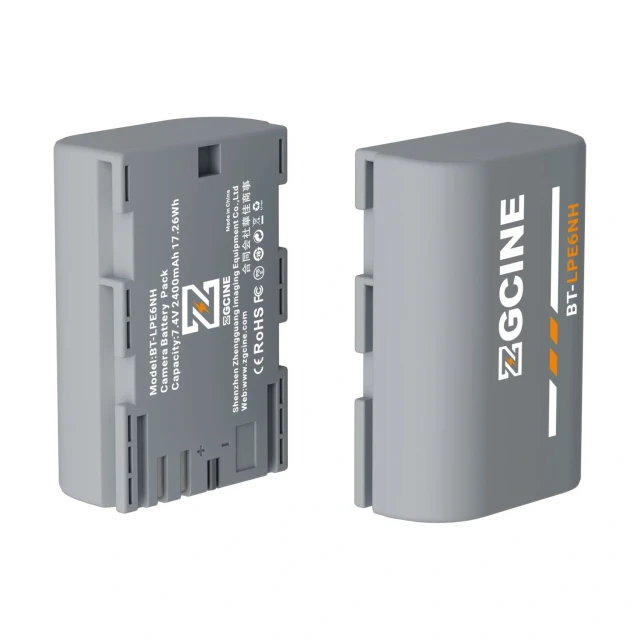
Charging casesSmallRig 5105, SmallRig 5108 (with a power bank function) or ZGCINE PS-LPE6. The batteries are protected while you carry them and you can charge them even without a socket.
Battery + charging station kitsTilta TBC-E6P-A-GN or SmallRig 5485.
For long recordings, timelapses or studio work, a dummy battery is worthwhile; it powers the camera from a USB-C PD power bank, a mains adapter or a V-Mount battery via D-Tap: for example Tilta DB-LPE6-USBC, SmallRig 6540 (LP-E6P, USB-C) or SmallRig 4252 (D-Tap).
How many batteries you need
For everyday shooting with a DSLR (5D, 6D, 90D), one spare battery is often enough – the optical viewfinder uses little power. Mirrorless cameras have an electronic viewfinder and sensor stabilisation, so they drain the battery faster.
Stills on a mirrorless cameraFor an all-day event, plan on two to three batteries.
VideoRecording in 4K/8K with stabilisation and a bright screen uses power fastest. Three to four batteries or power from a power bank via a dummy battery are a sensible baseline.
WinterCapacity drops significantly in freezing temperatures. Carry spare batteries in a pocket close to your body and rotate them.
Care, storage and air travel
Store batteries you won't be using for a longer time charged to about half, in a dry place at room temperature. Don't leave them in a hot car and don't store them fully discharged for long periods. With original batteries, regularly check the wear status in the camera menu.
LP-E6 batteries have 13–16 Wh, well below the 100 Wh limit – take them on a plane in your hand luggage with the contacts covered.
Frequently asked questions
Can I put an LP-E6NH in a camera that was supplied with the LP-E6?
Yes. The LP-E6NH (and the LP-E6P) is backward compatible and lasts longer than the original LP-E6 in older cameras such as the 5D Mark III, 6D or 80D.
Does the old LP-E6 work in the EOS R5 or R6?
The battery fits and the camera runs on it, but it cannot be charged via USB in the body and lasts for a shorter time. We recommend the LP-E6NH or LP-E6P. Any further restrictions are listed in the camera manual.
Do I really need the LP-E6P for the EOS R5 Mark II?
The camera works with the LP-E6NH or LP-E6N, but with restrictions – according to Canon, 8K and 4K Fine recording, high frame rates, network functions and power-hungry accessories powered by the camera are among the features that are not available. The full list is in the camera manual. The oldest LP-E6 does not work in the R5 Mark II at all, and the same may apply to third-party batteries that identify themselves to the camera as LP-E6. If you want full performance, use the LP-E6P.
Will an LP-E6 charger also charge LP-E6P batteries?
The original Canon charger for the LP-E6 series charges all versions. With alternative chargers, go by the versions the manufacturer lists in the name or description.
Is a third-party battery dangerous for the camera?
Good-quality batteries from established accessory makers with overcharge and short-circuit protection are safe. Avoid anonymous batteries with an unrealistically high capacity on the label.