
 CZ
 SK
 HU
 AT
 DE
 ES
 SI
 HR

Nothing in the basket.

- Search
-
Login

-
0
Comparison
Add products to compare, then they will appear here and you can compare parameters.
-
0
0 €
Advice
Fujifilm NP-W126 & NP-W126S: Cameras, Differences, Chargers
The Fujifilm NP-W126 and NP-W126S battery powers most X series cameras – from the X-T1 and X-S10 to the X-E5 and X100VI. We explain the difference between the versions and help you choose a spare battery and charger.
Battery guide
Fujifilm NP-W126 & NP-W126S


Which cameras use the NP-W126 and NP-W126S battery
The NP-W126 (and the newer NP-W126S) is the most widespread battery in the Fujifilm X system. It is used by almost all small and mid-sized bodies, from the first X-Pro1 and X-E1 to the current X-T50, X-M5 and X100VI.
| Manufacturer | Model | Note |
|---|---|---|
| Fujifilm | X-T1, X-T2, X-T3 | X-T series – the larger X-T4 and X-T5 already use the NP-W235 |
| Fujifilm | X-T10, X-T20, X-T30, X-T30 II, X-T30 III | compact X-T series |
| Fujifilm | X-T50 | |
| Fujifilm | X-T100, X-T200 | |
| Fujifilm | X-Pro1, X-Pro2, X-Pro3 | |
| Fujifilm | X-E1, X-E2, X-E2S, X-E3, X-E4, X-E5 | |
| Fujifilm | X-S10 | its successor, the X-S20, uses the NP-W235 |
| Fujifilm | X-H1 | the X-H2 and X-H2S use the NP-W235 |
| Fujifilm | X-M1, X-M5 | |
| Fujifilm | X-A1, X-A2, X-A3, X-A5, X-A7, X-A10 | |
| Fujifilm | X half | |
| Fujifilm | X100F, X100V, X100VI | the older X100, X100S and X100T use a different battery (NP-95) |
If you can't find your model in the table, check the battery type in the manual. The X30, XF10 and other compacts use different batteries.
NP-W126 and NP-W126S battery variants
| Battery | Voltage / capacity | Note |
|---|---|---|
| NP-W126 | 7.2 V / 1260 mAh (8.7 Wh) | original version |
| NP-W126S | 7.2 V / 1260 mAh (8.7 Wh) | same capacity, better heat dissipation, supplied with newer bodies |
The difference is not in capacity. The NP-W126S has a modified housing and internal design that copes better with higher loads (fast burst shooting, 4K recording). The dimensions and contacts are the same.
Interchangeability: you can use the NP-W126S without restrictions in all cameras designed for the NP-W126. The older NP-W126 also fits and works in newer bodies; however, for models supplied with the NP-W126S, Fujifilm recommends using the S version. The difference shows mainly during intensive video recording.
In-camera charging: newer models (for example the X-T30, X-T3, X-S10, X-E4, X100V, X-T50) can charge the battery via USB in the body. Older and some higher-end bodies (e.g. X-T1, X-T2, X-Pro1, X-Pro2, X-E1, X-E2 and X-H1) cannot. Check support for your model in the manual.
Original or alternative battery?
The original Fujifilm NP-W126S (16528470) communicates fully with the camera and is the safest choice for newer bodies. It is currently out of stock; check availability on the product page.
Alternatives in stock – most have a USB-C port directly on the battery:
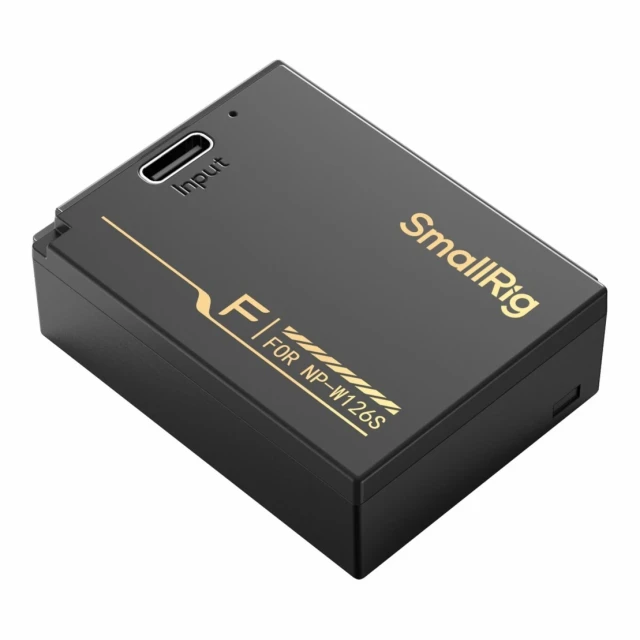
SmallRig 6099with USB-C charging.
SmallRig 5088(orange) and SmallRig 5062 – with USB-C.
Tilta TNP-W126S-AGand TNP-W126S-FG – 1050 mAh, USB-C input.
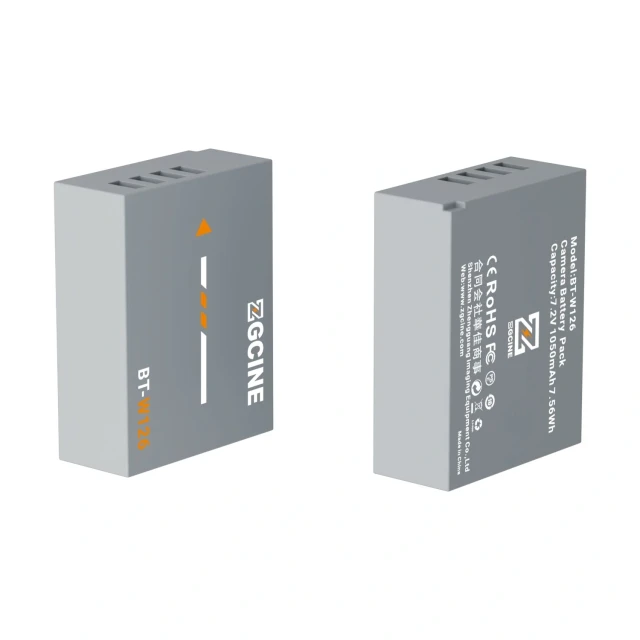
Third-party batteries may not display the charge level as accurately, and their declared capacity is not directly comparable with the original. A small battery heats up during video – with alternatives, it is advisable to watch whether the camera reports overheating sooner than with the original.
Chargers and charging cases
Original chargerFujifilm BC-W126 (16225925) – charges both the NP-W126 and NP-W126S; currently out of stock.
Dual-channel chargersTilta TBC-W126S-AG and TBC-W126S-FG.
Charging caseZGCINE PS-W126 with USB-C PD.
Battery + charger sets:K&F Concept KF28.0030V1 (2× 1300 mAh + 2-slot charger) and K&F Concept KF28.0147 (3× NP-W126S 1300 mAh + 3-slot charger).
For long recordings there is the ZGCINE DT-W126 dummy battery, powered from the D-Tap output of a larger battery.
How many batteries you need
The NP-W126S is a small battery, and mirrorless cameras with an electronic viewfinder drain it fairly quickly. For a full day of shooting, plan on two to three batteries; for video, three to four, or power from a power bank (on models that support it).
Runtime is shortened by continuous use of the viewfinder in high-performance mode, in-body stabilisation (on the X-S10, X-H1 and others), Wi-Fi/Bluetooth and the cold. In winter, keep spare batteries in a pocket close to your body.
Care, storage and air travel
Lithium-ion batteries are best stored at half charge (approximately 50%) in a dry place at room temperature. If you don't use a battery for several months, top it up occasionally so that it does not discharge completely. Don't leave it in a hot car or in direct sunlight, and don't charge it straight after bringing it in from the cold – let it warm up to room temperature first.
In winter, carry spare batteries in a pocket close to your body, not in your backpack. A cold battery shows a lower charge level and the camera may switch off sooner, but after warming up some of the capacity "comes back". Stop using batteries with a visibly swollen or damaged housing and hand them in at a collection point.
The battery has a capacity of 8.7 Wh, well below the 100 Wh limit – you can take it on a plane in your hand luggage (spare lithium batteries do not belong in checked baggage). Protect the contacts with a cover or a separate bag to prevent a short circuit.
Frequently asked questions
What is the difference between the NP-W126 and NP-W126S?
The capacity is the same (1260 mAh). The NP-W126S dissipates heat better and is designed for newer, more powerful bodies. Both versions are interchangeable; for newer models Fujifilm recommends the S version.
Does the NP-W126S fit the Fujifilm X100VI?
Yes, the X100VI, like the X100V and X100F, uses the NP-W126S. The older X100, X100S and X100T use a different battery, the NP-95.
Can I put an NP-W126S in the X-T5?
No. The X-T5 (like the X-T4, X-H2, X-H2S and X-S20) uses the larger NP-W235 battery.
Can the battery be charged in the camera?
On newer models, yes, via USB. Older and some higher-end bodies (e.g. X-T1, X-T2, X-Pro1, X-Pro2, X-E1, X-E2 and X-H1) do not support in-body charging; you charge the battery in a charger.
Overview of all battery systems
Related articles: Fujifilm NP-W235 Battery: Compatible Cameras, Batteries and Chargers.