
 CZ
 SK
 HU
 AT
 DE
 ES
 SI
 HR

Nothing in the basket.

- Search
-
Login

-
0
Comparison
Add products to compare, then they will appear here and you can compare parameters.
-
0
0 €
Advice
Canon LP-E17 Battery: Compatibility, Alternatives, Chargers
The Canon LP-E17 powers the EOS R8, RP, R10, R50, R100, EOS M series (M3–M6 Mark II) and 77D, 750D–850D, 200D and 250D. How many batteries to get and which alternatives, chargers and dummy batteries to choose.
Battery guide
Canon LP-E17 Battery


Which cameras use the LP-E17 battery
The LP-E17 is a small battery that Canon uses in lightweight bodies. The advantage is low weight, the drawback a smaller capacity – which is why a spare battery is more useful with mirrorless cameras than elsewhere.
| Manufacturer | Model | Note |
|---|---|---|
| Canon | EOS R8 | full-frame mirrorless camera |
| Canon | EOS RP | full-frame mirrorless camera |
| Canon | EOS R10, EOS R50, EOS R50 V, EOS R100 | APS-C mirrorless cameras |
| Canon | EOS M3, M5, M6, M6 Mark II | APS-C mirrorless cameras, EF-M mount |
| Canon | EOS 77D | APS-C DSLR |
| Canon | EOS 750D, 760D | APS-C DSLRs |
| Canon | EOS 800D, 850D | APS-C DSLRs |
| Canon | EOS 200D, 250D | compact APS-C DSLRs |
Watch out for mix-ups: the EOS M50, M50 Mark II, M100 and M200 use the smaller LP-E12 battery, not the LP-E17. If you can't find your model in the table, check the battery type in the manual or on the label of the original battery.
LP-E17 battery variants
Unlike the LP-E6, Canon has not released any "N" or "NH" versions of the LP-E17. The original comes in a single version:
| Battery | Voltage | Capacity | Energy |
|---|---|---|---|
| Canon LP-E17 | 7.2 V | 1040 mAh | 7.5 Wh |
The same battery therefore fits all the cameras in the table. Some newer models can charge the LP-E17 via USB directly in the body – check your manual to see whether yours can (look for USB charging or a USB PD power adapter). Older DSLRs such as the 750D or 200D charge only in an external charger.
Original or alternative battery?
An original Canon battery guarantees an accurate charge level display, support for in-body charging and no unknown-battery messages. It is, however, more expensive.
Alternative batteries tend to be cheaper and some have a USB-C port directly in the battery – you can charge them with your phone cable without a charger. What to look out for:
CapacityThe mAh figure comes from the alternative's manufacturer. Batteries with a USB-C port often have the same or lower capacity than the original because of the charging electronics inside (for example Tilta 950 mAh versus 1040 mAh for the original).
Communication with the cameraThe remaining capacity display may differ, and after insertion the camera may display a battery communication message. You usually just need to confirm it.
FirmwareThere is no guarantee that a third-party battery's behaviour won't change after a firmware update.
LP-E17 batteries from our range
K&F Concept LP-E17 1250 mAh (KF28.0014V3)single battery.
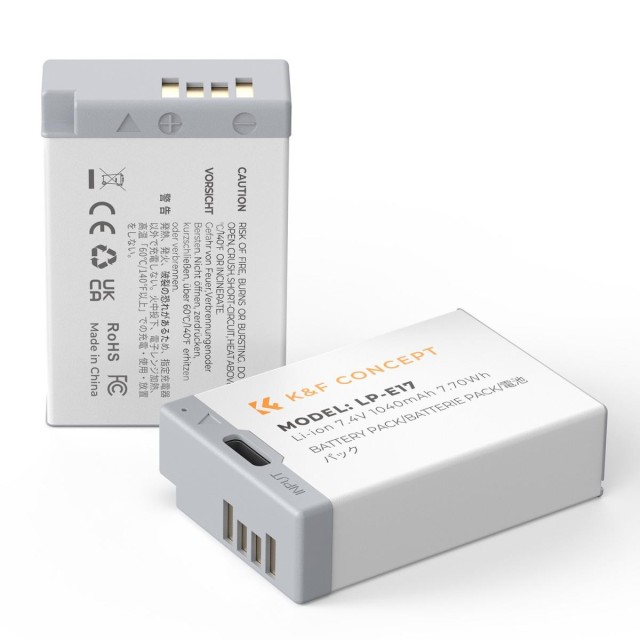
K&F Concept LP-E17 1040 mAh with USB-C charging, 2 pcs (KF28.0049S1)a pair of batteries charged directly via USB-C.
K&F Concept LP-E17 1250 mAh, 3 pcs + 3-slot charger (KF28.0052)a set of three batteries with a charger, the best value for video.
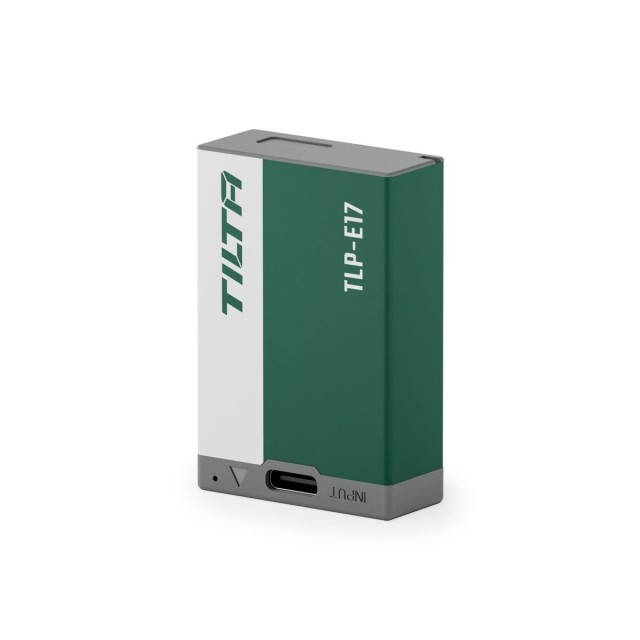
Tilta LP-E17 with USB-C, 950 mAh (TLP-E17-FG), also available in the colour TLP-E17-AG – with a USB-C input.
Chargers and charging cases
The original Canon charger is designated LC-E17E. Alternatives include:
USB-powered dual-slot chargerK&F Concept KF28.0008. Charge from an adapter, a power bank or in the car.
Sets with a chargerK&F Concept LP-E17 1250 mAh, 3 pcs + 3-slot charger (KF28.0052) includes a 3-slot charger.
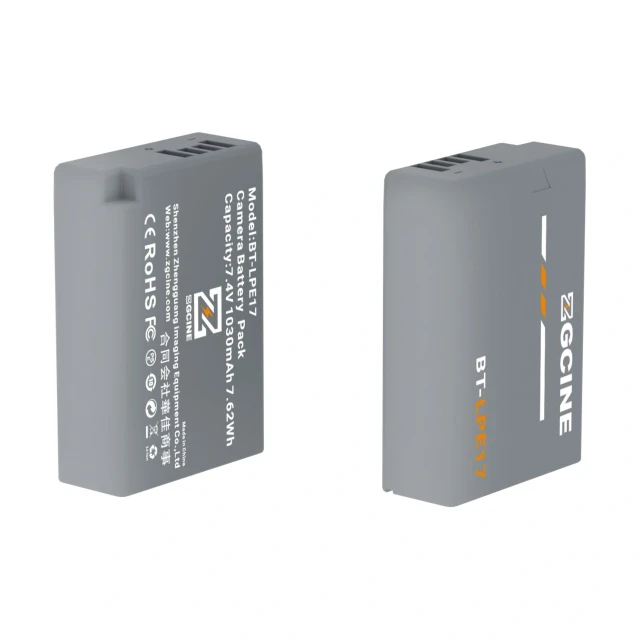
Charging caseZGCINE PS-E17 protects the batteries while you carry them and charges them at the same time.
For streaming, timelapses or long recordings, use a dummy battery: ZGCINE PD-LPE17 powers the camera from a USB-C PD adapter or power bank, ZGCINE DT-LPE17 from a large battery with a D-Tap output.
How many batteries you need
The LP-E17 has roughly half the energy of the LP-E6, so with the R8, R10, R50 or RP mirrorless cameras a spare battery is almost a must.
Trips and everyday shootingOne or two spare batteries.
Video and vloggingRecording in 4K with the electronic viewfinder or vari-angle screen drains the battery quickly. Plan on three batteries, or power from a power bank via a dummy battery.
WinterSmall batteries suffer most from the cold. Carry spares in a pocket close to your body.
DSLRs (77D, 800D, 850D, 200D, 250D) with an optical viewfinder last significantly longer on a single charge than mirrorless cameras with the same battery.
Care, storage and air travel
Store unused batteries charged to about half, in a dry place at room temperature, away from direct sunlight and hot cars. The LP-E17 has 7.5 Wh, so you can take it on a plane in your hand luggage without any problem (the limit is 100 Wh) – cover the contacts.
Frequently asked questions
Does the LP-E17 fit the EOS M50?
No. The EOS M50 and M50 Mark II use the smaller LP-E12 battery. The LP-E17 is for the M3, M5, M6 and M6 Mark II.
Is the LP-E17 the same as the LP-E6?
No. The LP-E6 is larger and has a higher capacity; the batteries are not interchangeable. The EOS R8 may look similar to the R6 Mark II, but it uses the LP-E17.
Can I charge the LP-E17 via USB-C in the camera?
Only on models that support it – check the manual. If your camera can't charge in the body, choose a battery with its own USB-C port or a USB-powered charger.
Will the camera show the status of a third-party battery?
On DSLRs usually yes. On mirrorless bodies such as the EOS RP, R10 or the M series, third-party batteries often do not show the remaining capacity – check the product description of the specific battery. Sometimes the camera displays a message after insertion that you simply confirm.