CZ
 SK
 HU
 AT
 DE
 ES
 SI
 HR

Nothing in the basket.

- Search
-
Login

-
0
Comparison
Add products to compare, then they will appear here and you can compare parameters.
-
0
0 €
Advice
V-Mount Batteries: How to Choose Capacity, Power, Outputs
V-Mount (V-Lock) batteries power cinema cameras, monitors, wireless video transmitters and LED lights. We explain how to read capacity in Wh and power in amps, what D-Tap and USB-C outputs are for, how mini V-Mount differs and what rules apply to air travel.
Battery guide
V-Mount Batteries


Which devices V-Mount batteries power
V-Mount is a standardised mount, not a battery for one specific model. Some devices have it built into the body, others need a battery plate.
| Device type | How it connects | Note |
|---|---|---|
| Cinema cameras (e.g. Blackmagic URSA, RED, Sony FX9 cameras) | Directly or via a V-Mount plate for the specific camera | Check the camera's voltage and power draw; for specific models there are plates such as the SWIT S-7020S (URSA), SHAPE REDVM (RED) or Tilta for the Sony FX9. |
| Mirrorless and smaller cameras | Plate on a cage or rods + D-Tap / USB-C to dummy battery cable | The camera receives power via a dummy battery, which must match the camera's battery type. |
| Monitors, recorders, wireless transmitters | D-Tap output or their own V-Mount holder | Keep an eye on the total draw of all connected devices. |
| LED lights | Directly (V-Mount on the light) or via an adapter | Powerful lights need high-current batteries, often two at once. |
| Laptops, phones, tablets | USB-C PD output | USB-C output varies by battery model. |
Professional camcorders use their own battery systems (Sony BP-U, Canon BP-A, Panasonic AG-VBR) – see our guide to professional camcorder batteries.
V-Mount battery variants
Capacity in watt-hours (Wh)
V-Mount battery capacity is stated in Wh because they have a higher voltage (nominally around 14.4–14.8 V, up to 16.8 V when charged) than small camera batteries. A rough runtime estimate: capacity in Wh divided by the rig's power draw in W. For example, 99 Wh / 40 W ≈ 2.5 hours; in reality, expect a lower figure due to losses, cold and cell ageing.
| Class | Typical use | Examples from our range |
|---|---|---|
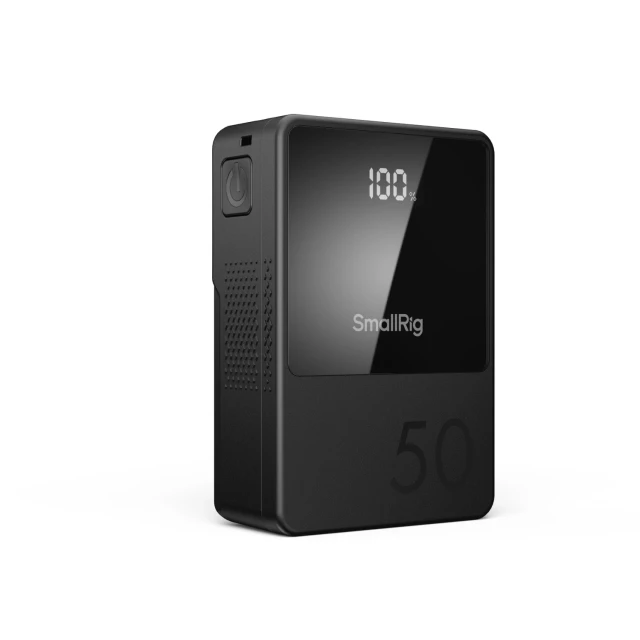
| Up to 50 Wh | Lightweight mirrorless rigs, a monitor, a small light, a gimbal | SmallRig VB50 3579B, K&F Concept KF28.0059 |
| Around 99 Wh | The most versatile choice, can be taken on a plane | SmallRig VB99 SE 4608, K&F Concept KF28.0092, SmallRig X99 4984 |
| 150–220 Wh | All-day operation of cinema cameras and powerful lights | SmallRig VB155 3581B, SmallRig VB212 4293, ZGCINE ZG-S200 |
| Dividable | High capacity that can still be taken on a plane | SWIT S-8192S (2 × 92 Wh) |
Power and current (A)
Capacity tells you how long the battery will last; the maximum current tells you how many devices it can handle at once. Work out the required power as the sum of the power draw of all devices; the battery's power is voltage × current (e.g. 14.4 V × 10 A ≈ 144 W). Small batteries tend to have a lower maximum current than large ones – so for powerful lights or demanding cameras, check the maximum load figure (called "high load" by some manufacturers). If the current is insufficient, the battery's protection may shut it off even when it is charged.
Mini V-Mount
"Mini" refers to a smaller, lighter battery body; the mount is the same as on a standard V-Mount battery. Mini batteries are suited to lightweight rigs, gimbals and handheld shooting, as they put less load on the back of the rig. With larger capacities (e.g. 155 or 212 Wh in a mini version), however, the weight still increases.
Outputs: D-Tap, USB-C, USB-A and DC
D-TapThe most common output for monitors, transmitters and cables to dummy batteries. It usually carries the unregulated battery voltage (approx. 12–16.8 V); the device must tolerate this range, or you need to use a cable with a regulator.
USB-C PDOn newer batteries it is often bidirectional: you can charge the battery through it and also power a laptop or phone. Output varies (e.g. 65 W on the K&F Concept KF28.0024, 100 W on the KF28.0092, up to 140 W on the SmallRig VB212).
Regulated DC outputs (8 V, 12 V)Found on some batteries for powering cameras directly via a dummy battery, or for voltage-sensitive devices.
DisplayShows the remaining capacity and possibly an estimated runtime or the current draw; on smart models (SmallRig X-Touch) also via an app.
Contacts with or without communication
Besides the power pins, a V-Mount battery's contact often has a communication pin, through which the camera can display the remaining capacity. Without it, the camera shows only the voltage or nothing at all. The function depends on the camera, the plate and the battery – if displaying the status in the camera matters to you, check support for the specific combination. Also watch out for different systems: Gold Mount (a three-stud mount) and B-Mount are not compatible with V-Mount without an adapter.
Original or third-party battery?
There is no single "original" for V-Mount – batteries are made by many brands (IDX, SWIT, Blueshape, Core SWX, SmallRig, ZGCINE, K&F Concept…). Choose based on specifications and support: capacity, maximum current, outputs, weight, display and service availability. More expensive professional batteries usually offer more accurate status information, a more rugged design and better-documented load ratings; cheaper models are sufficient for lightweight rigs, monitors and lights.
Chargers and charging plates
Directly via USB-CMost newer batteries (e.g. the SmallRig VB99 SE) can be charged with a USB-C PD adapter; charging time depends on the adapter's output.
Four-channel chargersFor productions with multiple batteries, e.g. the SWIT PC-P461S.
How many batteries you need
Add up the power draw of the camera, monitor, transmitter and other devices and divide the battery capacity by it – this gives you a rough runtime for one battery. For a shooting day, allow a reserve of at least 30 % and bear in mind that some batteries will be charging while others are in use. Powerful lights consume more than the camera; plan separate batteries for them. In winter, capacity drops – store batteries somewhere warm and charge them only once they have warmed up.
Care, storage and air travel
For longer periods, store V-Mount batteries charged to about 50 % in a dry place at room temperature. The rules for air passengers depend on the capacity in Wh:
Up to 100 WhIn hand luggage, usually without the airline's approval (which is why so many batteries are 95–99 Wh).
100–160 WhOnly with the airline's approval, usually no more than two spare batteries.
Over 160 WhCannot be carried on passenger aircraft.
Spare batteries always belong in your hand luggage with protected contacts, never in checked baggage. Your airline may have stricter rules – check them before you travel. Dividable batteries (e.g. the SWIT S-8192S) are designed to be split into two pieces under 100 Wh for transport.
Frequently asked questions
Is V-Lock the same as V-Mount?
In practice, yes – both names refer to the same battery mount, and the batteries and plates are mutually compatible.
Does a mini V-Mount battery fit a standard V-Mount plate?
Yes, the mount is the same. Just check that the battery can deliver the current your rig needs.
Can I take a 99 Wh battery on a plane?
Yes, batteries up to 100 Wh can usually be carried in hand luggage. Follow the rules of your specific airline.
Can I power a camera from D-Tap?
Yes, but only via a cable with a dummy battery and a voltage regulator designed for your camera. Connecting directly to unregulated D-Tap could damage the camera.
Can I charge the battery and power devices from it at the same time?
Some models allow this, others don't. Check the description of the specific battery to see whether it supports pass-through charging.