
 CZ
 SK
 HU
 AT
 DE
 ES
 SI
 HR

Nothing in the basket.

- Search
-
Login

-
0
Comparison
Add products to compare, then they will appear here and you can compare parameters.
-
0
0 €
Advice
Sony NP-BX1 Battery for RX100 and ZV-1: Variants, Chargers
The Sony NP-BX1 is a small battery for RX100 compacts (all generations), the ZV-1, ZV-1 II, ZV-1F, RX1 and HX models. We help you choose spare batteries and a charger.
Battery guide
Sony NP-BX1 Battery for RX100 and ZV-1


Which cameras and camcorders use the NP-BX1
The NP-BX1 (InfoLithium X series) is found in small Sony cameras where space for the battery is limited. That is why it also has a small capacity, and a spare battery is almost a necessity with these devices.
| Manufacturer | Model | Note |
|---|---|---|
| Sony | RX100, RX100 II, III, IV, V, VA, VI, VII | all generations of the RX100 series |
| Sony | ZV-1, ZV-1 II, ZV-1F | vlogging compacts |
| Sony | RX1, RX1R, RX1R II | compact with a full-frame sensor |
| Sony | Cyber-shot HX50V, HX60V, HX80, HX90V, HX99, HX400V | compacts with a long zoom |
| Sony | Handycam HDR-CX240, HDR-CX405, HDR-PJ410 | compact Full HD camcorders |
| Sony | HDR-AS50, FDR-X3000 action cams | older Sony action cameras |
If you don't see your model in the table, check the battery type in the manual or on the label of your current battery.
NP-BX1 battery variants
Sony makes just one version of the NP-BX1: nominal voltage 3.6 V, capacity 1240 mAh (4.5 Wh). Unlike other systems, there are no generations with a letter at the end. Alternatives differ in the capacity stated by the manufacturer, the quality of the cells and whether the battery comes with a charger.
Don't confuse it with other Sony batteries with similar names (NP-BN1, NP-BG1 etc.) – they have a different shape and don't fit devices designed for the NP-BX1. The miniature RX0 and RX0 II cameras use a different, smaller battery, the NP-BJ1.
Original or third-party battery?
The original Sony NP-BX1 is currently out of stock. Third-party batteries are commonly used with small compacts – the runtime of a single battery is short and the price of the original is high in relation to it.
What to expect from an alternative: the camera usually displays the charge level, but less accurately than with the original; the real runtime may differ from the figure in the product name. Older bodies may show an incompatibility message with some non-original batteries – if you run into problems, clean the contacts and fully charge the battery.
K&F Concept KF28.0134three 1240 mAh batteries and a 3-slot charger with USB-C, suitable for vlogging.
K&F Concept KF28.0044two batteries and a 2-slot charger (last units).
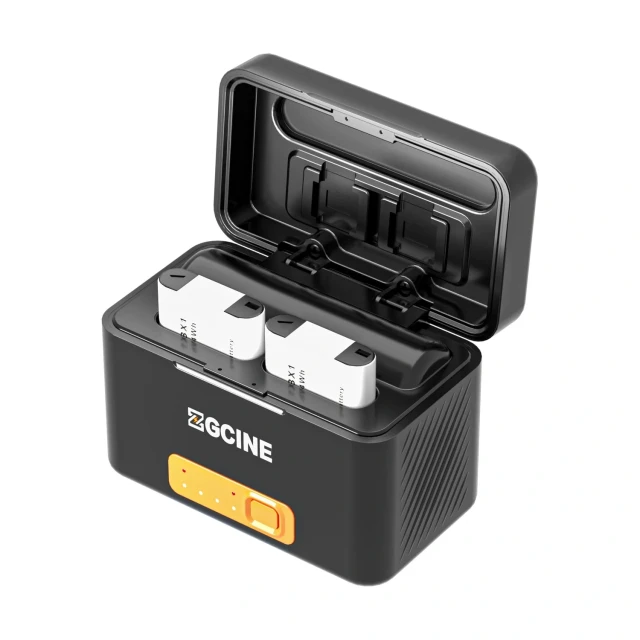
ZGCINE PS-BX1 Kit 2charging case with two batteries.
Chargers and charging cases
Most devices using the NP-BX1 charge the battery via USB directly in the body, and many of them come without a separate charger. This is convenient, but it means you can't shoot while charging and you only charge one battery. With spare batteries, an external charger or case therefore always makes sense.
Charger in a set:The K&F Concept KF28.0134 sets include a USB-C-powered charger.
Charging case:ZGCINE PS-BX1 – a case for two batteries that also charges them; ideal for travel.
How many batteries you need
The NP-BX1 has only 4.5 Wh, so runtime is short on all these devices. For a full day of shooting on holiday, plan on two to three batteries. With the ZV-1 and RX100, recording 4K video drains the battery quickly and the camera also heats up – for vlogging, take three to four batteries, or record while powered from a power bank via USB if your model supports it. In winter, carry spare batteries in a pocket close to your body.
Care, storage and air travel
Store unused batteries charged to about half and protect them from heat – small batteries suffer in a trouser pocket or in a car in the sun. Don't carry loose batteries in a pocket with keys or coins, as they can short-circuit; use a cover or a case.
On a plane, spare batteries always go in your hand luggage, not in checked baggage. Batteries of this type are well below the 100 Wh limit, so a normal number of them is usually no problem; protect the terminals with a cover or case.
Frequently asked questions
Is the RX100 battery the same as the ZV-1 battery?
Yes, all generations of the RX100 as well as the ZV-1, ZV-1 II and ZV-1F use the NP-BX1.
Can I charge the battery in the camera?
Yes, devices using the NP-BX1 usually charge via USB. However, it is slower and only one battery at a time.
Does a non-original battery last as long as the original?
The capacity in the name is the battery manufacturer's figure. Good-quality alternatives come close to the original; cheap ones may last less and age faster.
Overview of all battery systems
Related articles: Sony NP-FW50 (ZV-E10, Alpha 6000)
