
 CZ
 SK
 HU
 AT
 DE
 ES
 SI
 HR

Nothing in the basket.

- Search
-
Login

-
0
Comparison
Add products to compare, then they will appear here and you can compare parameters.
-
0
0 €
Advice
Ricoh DB-110 and Olympus LI-92B/LI-90B: GR III and TG-7
Ricoh DB-110 and Olympus LI-92B/LI-90B batteries power the Ricoh GR III, GR IIIx, WG-6/WG-7 and rugged TG-5 to TG-7. We explain how they differ, whether they are interchangeable and which spare battery and charger to choose.
Battery guide
Ricoh DB-110 and Olympus LI-92B/LI-90B
Which cameras use the DB-110 and Li-90B battery
The Ricoh DB-110 and the Olympus (now OM System) LI-90B are small single-cell batteries of the same format. You will find them in Ricoh GR pocket cameras and in the rugged Olympus/OM System Tough compacts.
| Manufacturer | Model | Battery supplied by the manufacturer |
|---|---|---|
| Ricoh | GR III, GR IIIx (the newer GR IV uses a different battery, the DB-120) | DB-110 |
| Ricoh | WG-6, WG-7, G900 | DB-110 |
| Olympus | Tough TG-5, Tough TG-6 | LI-92B |
| OM System | Tough TG-7 | LI-92B |
The older Ricoh GR and GR II use a different battery (DB-65). If you are not sure about your model, check the manual or the battery label.
Battery variants: DB-110 vs. LI-90B
| Battery | Voltage / capacity | Note |
|---|---|---|
| Ricoh DB-110 | 3.6 V / 1350 mAh | original for the GR III, GR IIIx, WG-6 |
| Olympus / OM System LI-92B | 3.6 V / 1350 mAh | original for the TG-5, TG-6, TG-7 |
| Olympus LI-90B | 3.6 V / 1270 mAh | older type with the same shape and contacts, lower capacity |
All three batteries have the same shape and contact layout, which is why third-party batteries are sold labelled for both types at once. Each manufacturer officially lists only its own battery in its manuals – using the "other" original is not confirmed by the manufacturer, even though it is common in practice.
In-camera charging: the Ricoh GR III and GR IIIx charge the battery via USB-C directly in the body, and the rugged TG-5, TG-6 and TG-7 compacts also charge the battery in the camera via USB. In-body charging is convenient, but you can't shoot while it charges – with an external charger, you can charge a spare battery while you shoot with another one.
Original or third-party battery?
Original Ricoh DB-110 and OM System LI-92B batteries guarantee full compatibility, an accurate charge indicator and trouble-free in-body charging. We don't currently have them in our range.
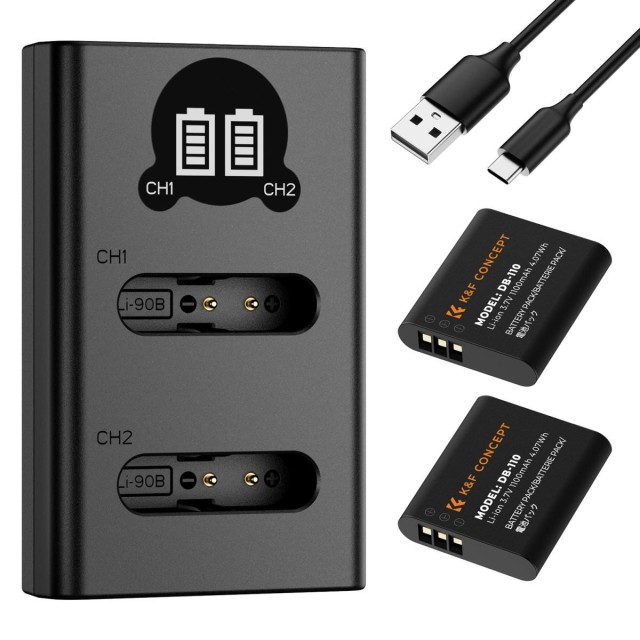
A practical alternative is the K&F Concept KF28.0051 set: two DB-110 / Li-90B batteries with a capacity of 1100 mAh and a two-slot charger powered via USB-C. According to the manufacturer, the alternative has a lower capacity than the original; its advantages are the price and the separate charger included in the package.
With non-original batteries, the camera may display the charge level less accurately, or in-body charging may not work the same way as with the original. The external charger from the set solves this problem.
Chargers and charging cases
Camera makers mainly expect in-body charging; both Ricoh (BJ-11) and OM System (UC-92) offer a separate charger as an accessory. For most users, the dual-channel charger from the K&F Concept KF28.0051 set, which you power from a USB-C adapter or power bank, is more practical.
How many batteries you need
The small batteries of pocket cameras don't last as long as those of larger bodies. For the Ricoh GR III and GR IIIx, we recommend at least two to three batteries for a full day of shooting in the city or on the road.
The rugged TG compacts are often used in winter, in water and in the mountains. Cold and an active GPS/logging function increase consumption significantly – carry at least one charged spare battery kept warm close to your body.
Care, storage and air travel
Lithium-ion batteries are best stored at about half charge (approximately 50 %) in a dry place at room temperature. If you don't use a battery for several months, top it up occasionally so that it doesn't discharge completely. Don't leave it in a hot car or in direct sunlight, and don't charge it right after bringing it in from the freezing cold – let it warm up to room temperature first.
In winter, carry spare batteries in a pocket close to your body, not in your backpack. A cold battery shows a lower charge level and the camera may switch off sooner, but some of the capacity "comes back" once it warms up. Stop using batteries with a visibly swollen or damaged casing and take them to a collection point.
The battery has a capacity of roughly 4.6–4.9 Wh, well below the 100 Wh limit – you can take it on a plane in your hand luggage (spare lithium batteries do not belong in checked baggage). Protect the contacts with a cover or a separate pouch to prevent a short circuit.
Frequently asked questions
Does the Li-90B battery fit the Ricoh GR III?
The dimensions and contacts are the same, and third-party batteries are sold for both types. However, Ricoh officially lists only its own DB-110 – if you want to be sure, use the original or an alternative labelled for the DB-110.
Can I use the battery from the GR II in the GR III?
No. The GR II and older GR models use a different battery (DB-65), which does not fit the GR III.
Does the TG-6 charge the battery in the camera?
Yes, the rugged TG-5, TG-6 and TG-7 compacts charge the battery in the camera via USB. If you have several batteries, an external charger is worth it.

