
 CZ
CZ SK
SK HU
HU AT
AT DE
DE ES
ES SI
SI HR
HR
Nothing in the basket.

- Search
-
Login

-
0
Comparison
Add products to compare, then they will appear here and you can compare parameters.
-
0
0 €
News
Convergent Design released Firmware 2016.06, the largest, most comprehensive ever offered by Convergent Design, for its monitors/recorders Apollo and Odyssey. 23 new features plus 22 fixes and improvements to current functions cover the Apollo, Odyssey7Q+, Odyssey7Q, and Odyssey7 models. All of these updates are free to the owners of the Apollo and Odyssey products.
Convergent Design Apollo
Apollo Double Master Recording. Double Master Recording captures files to two SSDs simultaneously for instant backup. Hand one off to production and hold the other for safe keeping.
Apollo A/V Align. Intermix cameras with different signal latency and keep both audio and video in sync. Mix cameras from different manufacturers and with different signal processing and compensate for their delays in outputting signals.
3:2 Pulldown Removal. Intermix HD 3:2 Pulldown video cameras with 24p cameras. Mix cameras that output 24p as 1080i60 with embedded 3:2 pulldown and cameras that output 1080p24, all on the fly with matching timecode.
Live Switching Dissolves. Three speeds of dissolves available in live switching. A shortcut button allows alternating between cuts and dissolves for a more professional live edit.
Eight-Channel Audio. Eight tracks of audio for each SDI video input. Apollo Dual-4K offers up to 16 total audio tracks and Apollo Quad-HD offers up to 32 audio tracks. (All Odyssey models and Apollo).
Odyssey RAW Bundle
Sony FS5 RAW. Sony PXW-FS5 RAW Recording in CinemaDNG or Apple ProRes. 4K60p, 4K120p Burst, 2K240p. Odyssey provides the most complete support of Sony FS cameras in the industry. (Odyssey7Q/Odyssey7Q+ w/ Odyssey RAW Bundle).
IO Flare 4K RAW. IO Flare 4K RAW Recording in CinemaDNG. 4K60p. The only portable RAW recorder for the IO Industries cameras. (Odyssey7Q/Odyssey7Q+w/ Odyssey RAW Bundle).
Eight-Channel Audio. Eight tracks of audio for each SDI video input. Apollo Dual-4K offers up to 16 total audio tracks and Apollo Quad-HD offers up to 32 audio tracks. (All Odyssey models and Apollo).
New Software
CD Apple ProRes Transfer Tool v2.4 (New Version). For Apollo multitrack files, select which tracks to transfer. Offload a Live-Switch or Quad-Split quickly to give to a client and then later offload all of the files.
Date: 10. 06. 2016,
Category: News
FULL ARTICLE
Press Release
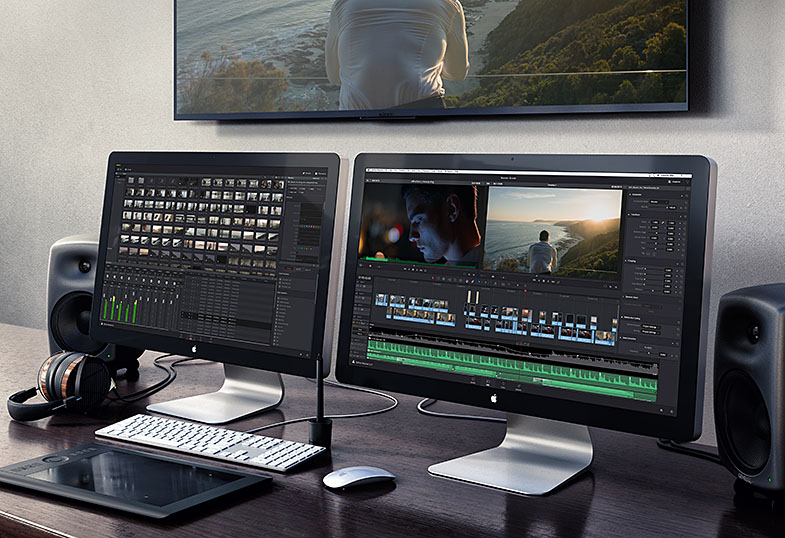
DaVinci Resolve 12.5 is a massive update with over 1,000 enhancements and 250 new features which includes major additions to the editing toolset, new and enhanced color features, including improved HDR support, and powerful new effects. DaVinci Resolve 12.5 is available now for download from the Blackmagic Design website.
DaVinci Resolve 12.5 is designed to make it easier for professional editors and colorists to work faster and have more creative options than ever before. With millions of editors now using DaVinci Resolve, Blackmagic Design engineers have been gathering feedback from customers and adding the features they’ve asked for. DaVinci Resolve 12.5 adds dozens of new editing and trimming features such as new swap and shuffle edits, seven entirely new trim operations, paste inserts, an expanded edit overlay with ripple overwrites and append edits, and much more. In addition, timeline performance has been greatly improved so editing is faster and the new Cinema Viewer option plays video full screen, making it easier for customers to preview their cut on laptops or systems with a single display.
DaVinci Resolve 12.5 introduces an entirely new way to navigate clips using audio waveforms. The source viewer features a revolutionary audio waveform overlay that allows you to see the audio waveform and video clip at the same time. This is the fastest way to navigate to different parts of a clip based on spikes, silent areas or other visual cues in the audio waveform.
DaVinci Resolve 12.5 also adds dozens of new media management and metadata features that make it easier for both assistants and editors to organize and work with massive amounts of media. A new metadata keyword dictionary makes it easier to choose common or previously created keywords and quickly apply them to clips. Metadata can now also be imported or exported via CSV files. Media Pool metadata columns can also be customized and saved, colors can be assigned to specific clips, and markers can now be single frame or durational. Display names, which are used throughout the software, can be automatically created based on metadata tags such as scene, shot and take information, saving editors hours when importing and working with large amounts of footage. New Power Bins in the Media Pool allow sharing of content between projects, making them perfect for graphics, stock footage and sound effect or music libraries that are used across multiple projects.
DaVinci Resolve 12.5 introduces an entirely new way to create custom retime effects and speed ramps. There are now separate curves for both frame position and playback speed. This allows any frame to be moved to any point in time, while also allowing variable speed changes between any range of frames. These powerful new controls make it easier to create unique retiming effects that were never possible before.
The timeline curve editor has been improved so customers can now select, move, and edit groups of multiple keyframes at the same time. There are also new visual controls for adding or selecting keyframes, as well as a menu for selecting specific parameters and curves to edit.
For colorists, DaVinci Resolve 12.5 introduces major enhancements to the node editor so now it’s possible to quickly navigate between nodes, swap nodes, select multiple nodes with a lasso, copy node contents, extract nodes, use embedded alpha channels in mattes and more. When dragging a saved grade from the gallery, customers now have the option to drag the grade in as a single compound node, or as a fully expanded node tree. These changes allow professional colorists to work even faster, while also making it more intuitive for video editors that are learning how to use Resolve’s massive set of color correction tools. In addition, there is a new single point tracker, new temperature and tint sliders have been added to the primary grading controls, additional XRite Colorchecker charts are now supported in the Color Match palette and customers can now select and modify multiple control points at the same time when working with Power Curve Windows.
With cameras such as Blackmagic Design’s URSA Mini 4.6K that already shoot with the latitude needed for HDR work, DaVinci Resolve 12 has already been used to grade more HDR content than any other system. DaVinci Resolve 12.5 Studio now includes major advances in HDR grading controls. Specific nodes can now be set to HDR mode which enables the grading tools in Resolve to work in an extended dynamic range especially designed for HDR deliverables such as Dolby Vision and HDR10. In addition, caching formats such as ProRes 4444 XQ and DNxHR now support extended dynamic range to serve as an efficient storage alternative to uncompressed 16-bit float files. These enhancements mean Blackmagic Design is the only company that offers a complete end to end HDR workflow from on set production to post production.
DaVinci Resolve 12.5 also introduces ResolveFX, a powerful new framework for native GPU and CPU accelerated effects. This release includes ResolveFX plug-ins such as GPU accelerated color space and gamma transformations, along with more traditional effects such as lens blur, light rays, emboss, dent, vortex, mirrors, gaussian and other blurs, glows, ripples, and more. Advanced ResolveFX tools like film grain, lens blurs and flares are available with DaVinci Resolve 12.5 Studio.
For more advanced visual effects work, the new Fusion Connect feature lets customers send clips to Fusion for additional visual effects. Fusion is Blackmagic Design’s advanced node based 3D compositing, visual effects and motion graphics software. When scenes are rendered out of Fusion, they automatically replace the clips on Resolve’s timeline. As effect shots are completed, the Fusion Connect clips in the Resolve timeline can be refreshed to show the most current version of the shot.
The Deliver page has been completely redesigned so now it’s easier to find presets, customize render settings and organize jobs. The new icon browser lets customers see and select output presets which include a new Premiere Pro export, along with presets for ProTools, Avid, Final Cut Pro, Vimeo, YouTube and more. In addition, audio can now be output independently of video as single or multichannel, and clips can be exported with an alpha channel when using supported codecs such as ProRes 4444, ProRes 4444 XQ and uncompressed RGBA.
In addition to all of the above features, DaVinci Resolve 12.5 Studio customers will also get dramatically improved spatial noise reduction which uses a superior multi GPU accelerated algorithm to reduce noise while retaining incredible detail. When combined with DaVinci Resolve 12.5’s enhanced temporal noise reduction controls, customers get the ultimate noise reduction toolset. DaVinci Resolve 12.5 Studio customers also get a new automatic correction tool for fixing barrel, pin cushion or perspective lens distortion, along with high quality de-interlacing, support for Camera LUTs, the DaVinci Color Transform Language (.dctl), and the ability to create ProRes remote render jobs on Windows machines. Customers can even use a terminal command to run a headless version of DaVinci Resolve without the GUI for remote rendering.
“The overwhelming success of DaVinci Resolve 12 has been incredibly exciting. Originally we planned DaVinci Resolve 12.5 to be focused on all the little things that make colorists' and editors' lives more productive, however its turned out that DaVinci Resolve 12.5 has become a major upgrade with a huge number of innovative new features,” said Grant Petty, CEO, Blackmagic Design. “I’d like to thank everyone for their huge support and positive feedback. This year we really wanted to take the time to address all of the finer details and the little things that make a huge difference to the pros that use it everyday, as well as new users learning the software. DaVinci Resolve 12.5 now includes virtually every imaginable editing and trimming tool! We are really excited about how quickly editors are switching, and we are committed to continue making it the best editing and color correction software in the world!”
Availability and Price
DaVinci Resolve 12.5 and DaVinci Resolve 12.5 Studio are now available for download from the Blackmagic Design website free of charge for all current DaVinci Resolve customers.
Press Photography
Product photos of DaVinci Resolve 12.5, and all other Blackmagic Design products, are available at www.blackmagicdesign.com/press/images.
About Blackmagic Design
Blackmagic Design creates the world’s highest quality video editing products, digital film cameras, color correctors, video converters, video monitoring, routers, live production switchers, disk recorders, waveform monitors and real time film scanners for the feature film, post production and television broadcast industries. Blackmagic Design’s DeckLink capture cards launched a revolution in quality and affordability in post production, while the company’s Emmy™ award winning DaVinci color correction products have dominated the television and film industry since 1984. Blackmagic Design continues ground breaking innovations including 6G-SDI and 12G-SDI products and stereoscopic 3D and Ultra HD workflows. Founded by world leading post production editors and engineers, Blackmagic Design has offices in the USA, UK, Japan, Singapore and Australia. For more information, please go to www.blackmagicdesign.com.
Date: 10. 06. 2016,
Category: News
FULL ARTICLE
2016 marks the 25th anniversary of the legendary TVPaint animation technology! For the occasion, TVPaint Developpement produced a short movie Journey Through Creativity. The piece was single-handedly designed, animated, and directed by Tévy Dubray, a twenty-two-year-old French-Cambodian animator. Her animation is paired with the music of Louis Warynski (aka Chapelier Fou), an electronic musician from TVPaint Developpement's hometown of Metz, France. As a gift to the users, the majority of the short's files created in TVPaint Animation 11 will be made available this summer on TVPaint Developpement's website.
Journey through Creativity - TVPaint 25th Anniversary from TVPaint on Vimeo.
Date: 09. 06. 2016,
Category: News
FULL ARTICLE
Genus Production Matte Box is designed to be flexible enough to use with lenses from small DSLR-sized primes to cinema zooms. Complete system with top flag, side flags optional. It contains Production Matte Box Rayshade, Top Flag, 2 x Filter Trays (rear tray 360 degrees fully rotatable), 15mm Rod to Matte Box Mount Bracket (Centre to Centre 60mm), 114mm Do-Nut, 82mm Interface, and a set of 82mm Step-Up Rings comprising of (52mm to 82mm; 58mm to 82mm; 62mm to 82mm; 67mm to 82mm; 72mm to 82mm; 77mm to 82mm; 82mm to 82mm.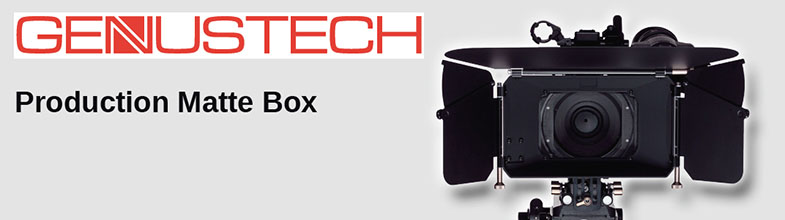
Date: 09. 06. 2016,
Category: News
FULL ARTICLE
Recent security issues related to Apple’s QuickTime 7 on Windows have been of concern to users of Adobe's products on that platform. Adobe announced it has been able to accelerate work that was already in progress to support native reading of ProRes. This new capability is fully licensed and certified by Apple, and barring any unforeseen issues during pre-release, these fixes will be included into an update to the relevant products in Creative Cloud shortly.
Additionally, Adobe is planning on adding native export support to .mov wrapped files of DNxHD and DNxHR. This support will augment the currently supported import of DNxHD and DNxHR in .mov and .mxf and native export in .mxf. Similarly, in an effort to allow as many legacy files to be supported as possible Adobe Creative Cloud applications will also be supporting the reading of AAC Audio and PNG Compressed frames and the reading/writing of Animation frames. When these fixes are released most Windows users will have a seamless workflow for virtually all popular codecs even with QuickTime removed from the computer; however, Adobe anticipates that some older, less used legacy formats may not be directly supported and therefore no longer be accessible. Users may need to find a method of transcoding their legacy media.
Date: 08. 06. 2016,
Category: News
FULL ARTICLE